


My ants messor barbarus
How it all started
You are not going to believe what my brother gave me for my birthday. It was a large cardboard box, inside it a plastic box, with a lid, holes, and a long piece of cork in which someone had made strange circular spaces. A small tube was stuck inside the box, it was covered with cotton and something black was moving inside.
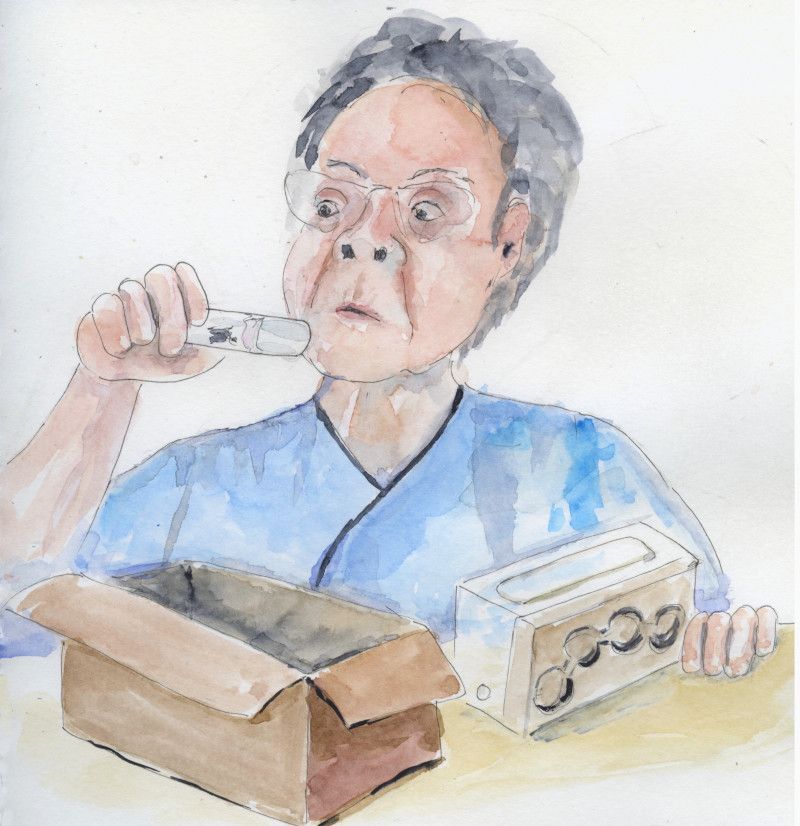
The gift
This is what I saw, with the help of a magnifying glass, it was a queen ant with several daughters and larvae and eggs. As it was written on a piece of paper, a "messor barbarus".
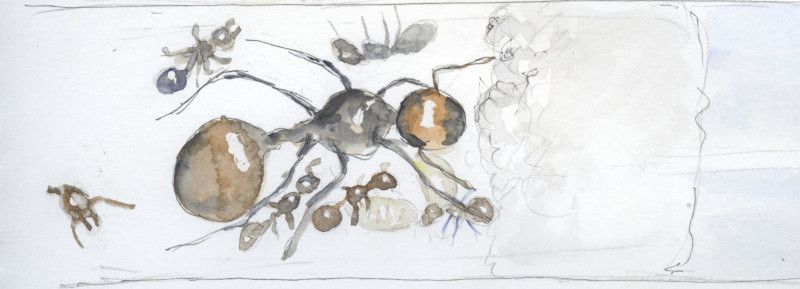
The queen messor and her first offspring
From what I have learned, queen ants can live up to 30 years, so it should have a name. I would like to call her Lola, but I don't know if it's a name for a queen, maybe she should be called Cleopatra or Berenice or at least Gertrude.
In view of the votes on instagram I decided to give it a name as a queen deserves, it is called " Lola Cleopatra ".
My first steps with the anthill
This was the first thing I did when I received my colony of mesor barbarus ants in a test tube. I put some sand, which came in a small sack, at the bottom of the methacrylate anthill. Then I removed the cotton plug that covered the end of the tube and placed it on top of the sand. I also put some seeds like the ones birds eat in the sand.
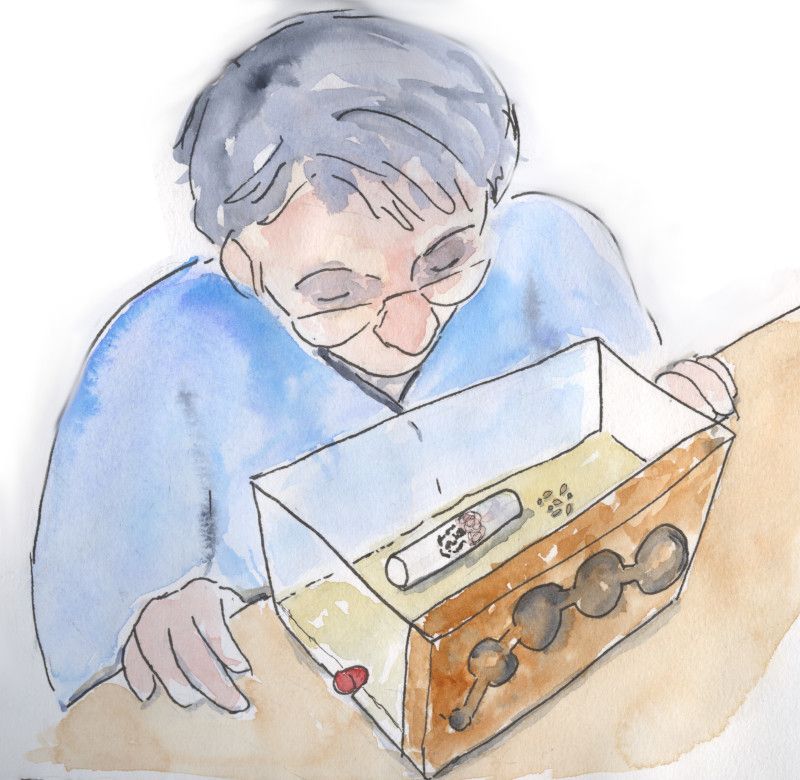
The first steps with the anthill
I started to look, to see if they decided to move to the cork plate that seemed designed for an ant house. But nothing, the queen was still attached to the cotton that separated her from the water in the tube. Some worker came out and put seeds inside the tube, some other wandered through the cork, but in the end they all ended up piled up on top of the queen and inside the tube.
As my ants were huddling against the cotton of the tube that separated them from the water, I thought that maybe they needed a more humid environment. I wanted to put a cotton ball with water inside the box, but I had an error and half of the sand got wet. Several workers began to dig enthusiastically in the wet sand. For several days they made many small caves, but of course, too shallow to be able to convince the queen to move into them.
One day I found against the wall of the box, in an area very far from the tube, a dead worker, was it due to strenuous work? Was she due to the depression of a job without results? Or maybe the little workers are just short lived.
The first dead ant
In any case I decided not to wait any longer, I had to help my ants to find an acceptable home ...
I filled a small plastic cup with sand for the anthill (a special sand that has a mixture of clay, so that when mixed with water it becomes rigid). Then I wet all the sand with water. I made a cut in the rim of the glass to act as a door, and then dipped some of the sand in with my finger so that it was shaped like a tube. I cut the base of the glass with a cutter to moisten the sand when it dries. I turned the glass upside down inside the anthill.
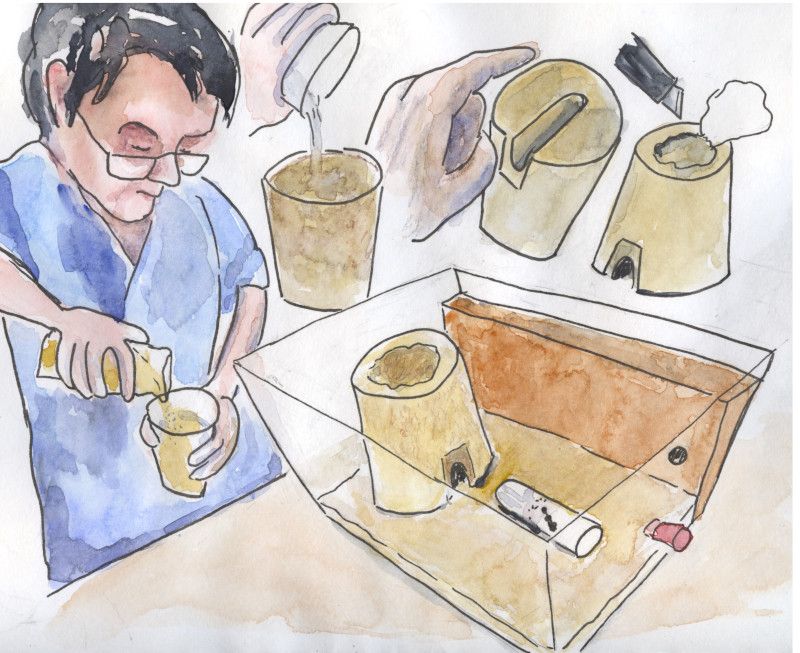
The castle is ready for Queen Lola Cleopatra!
The workers immediately liked the castle and began to move the eggs and larvae inside.
However, it was not so easy to convince Lola Cleopatra to move, my queen has an exaggeratedly conservative character. The workers pulled her by the jaws of her to get her out of the tube, but she turned around and put her head between the pink cotton that separated her from the water, then the workers insisted pulling her by her ass.
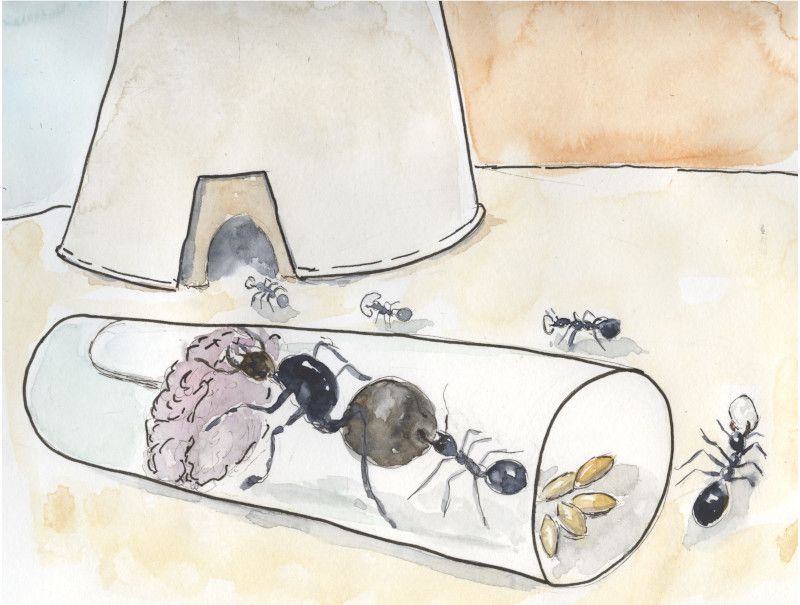
how difficult it is to convince a queen ...
After a long time they convinced her and now they are all inside the castle.
How is the anthill at the end
I explain how my ant-nest box has turned out after slightly changing the position of the box that they gave me from @ anthouse.es. When I realized that Lola Cleopatra (my queen messor barbarus) needed a lot of humidity, I made the castle with wet sand that is now the nest, and I also got two cheap hygrometers to know the humidity inside and outside the box.
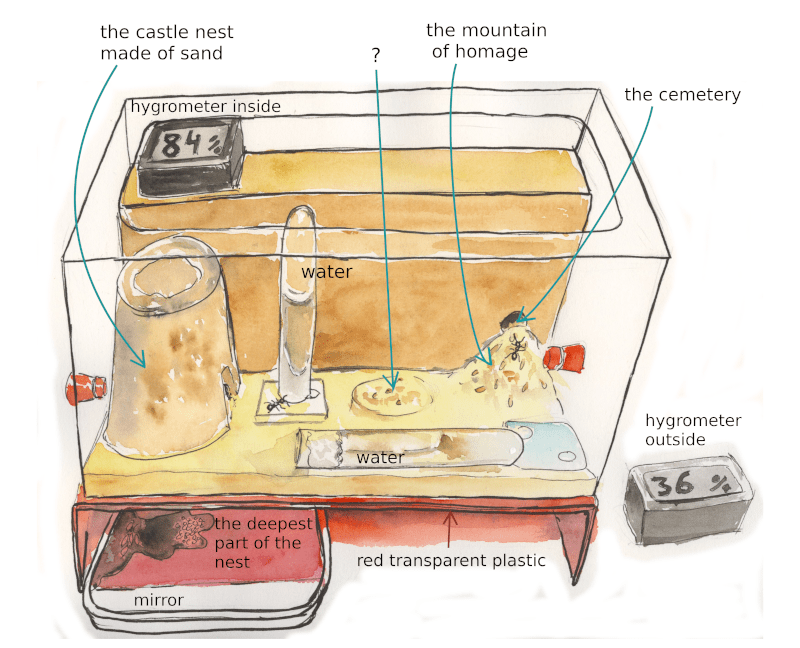
The ant box
I have placed the box on top of the transparent red plastic and I can see the bottom of the nest reflected in a mirror, with the eggs on one side and the seeds on the other.
On the outside of the castle I have put two tubes with water, and a concave surface in which I wanted to put food, but that they have filled with sand and have left certain seeds I do not know for what purpose (?) .
At the end of the box where the hole that leads to the cork nest is, the ants have created a mountain of sand and many more things, I don't know if it will correspond to what some call middens and others dump, but I will call "Mountain of homage". At the peak of that mountain is the tunnel leading to the cork nest chambers, which my ants have decided to make their cemetery.
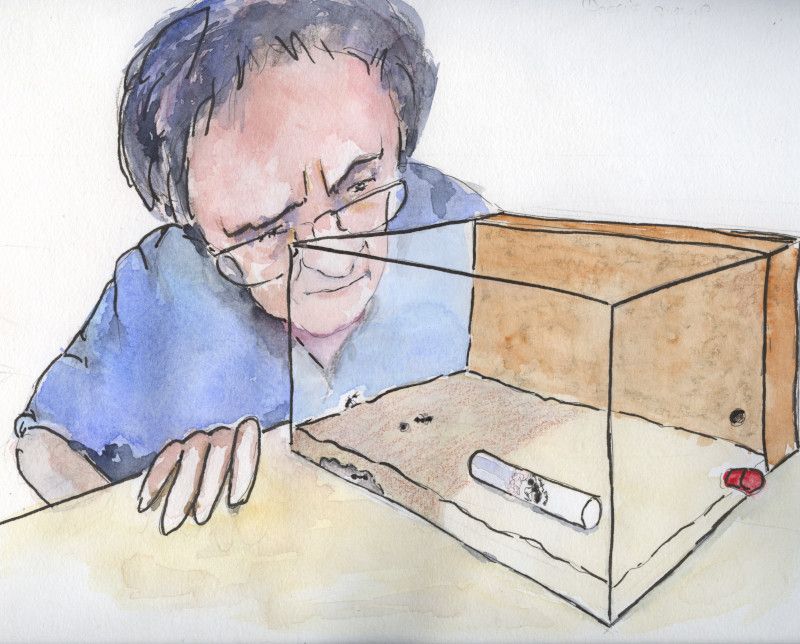
In the following figure you can see what the empty anthill was like, a transparent plastic box that comes with a lid that I have not drawn. Inside there is a cork plate with circular spaces to be used as a nest, it also came with a transparent red plastic to cover the nest (ants are blind to red light). The nest communicates through a hole with the foraging area, a place with sand, similar to the field, from where they would acquire food and water. The two holes on the sides of the box are used to communicate the anthill with others in case it is necessary to move the ants.
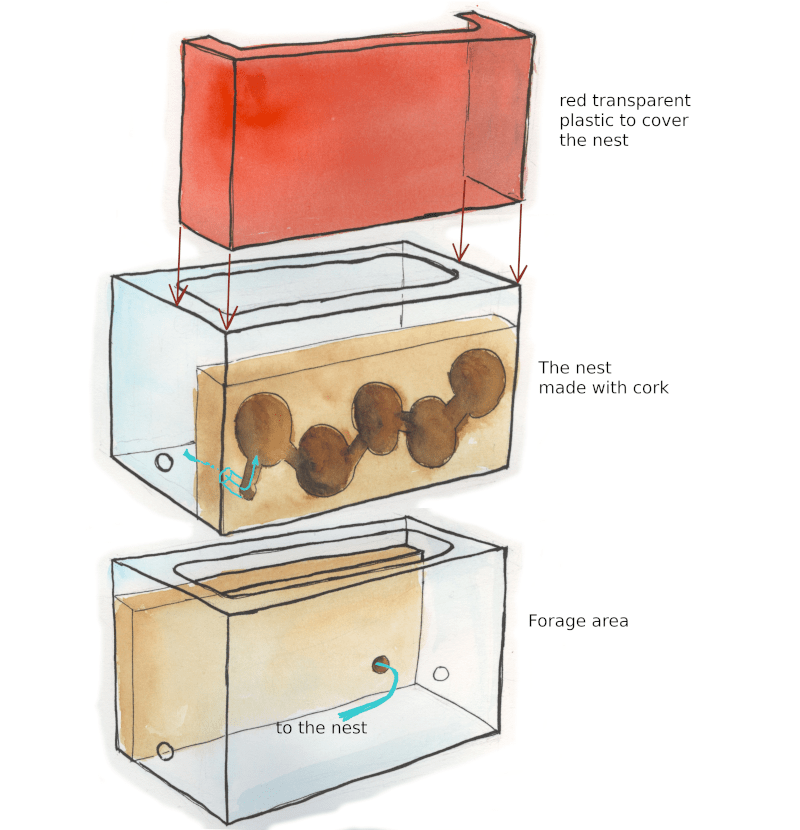
The empty methacrylate anthill
Comments powered by CComment