


Studying the normal (MITOSIS) and special (MEIOSIS) divisions of cells
As I explained to you in the Cells and Supercells chapter, my queen ant and I had decided to talk about reproduction, the function of those Supercells that we have inside our body and that is carried out by special divisions called "meiosis".
Lola Cleopatra and me have spent time thinking about how to explain meiosis, the special division of the nucleus of reproductive cells. But since we are not experts in biology, we have had to first study how a normal cell divided (mitosis). You'll have to forgive us if we make things up that we haven't quite figured out. If you want to make sure of what we say and you don't have any book at hand, look it up on wikipedia.
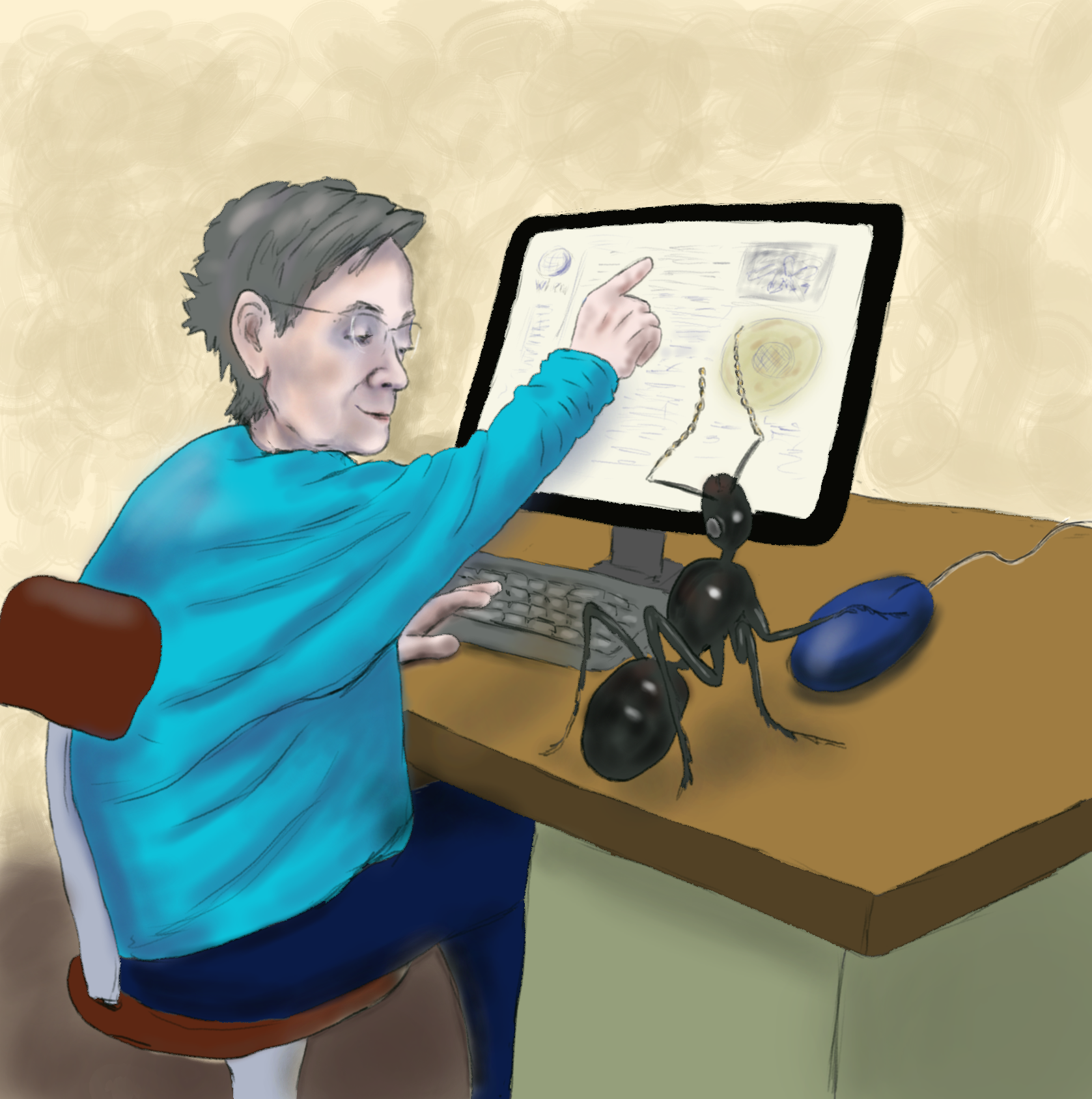
Choosing cell
We decided to first look at a normal cell that likes to divide a lot, we chose a cell from our gut.
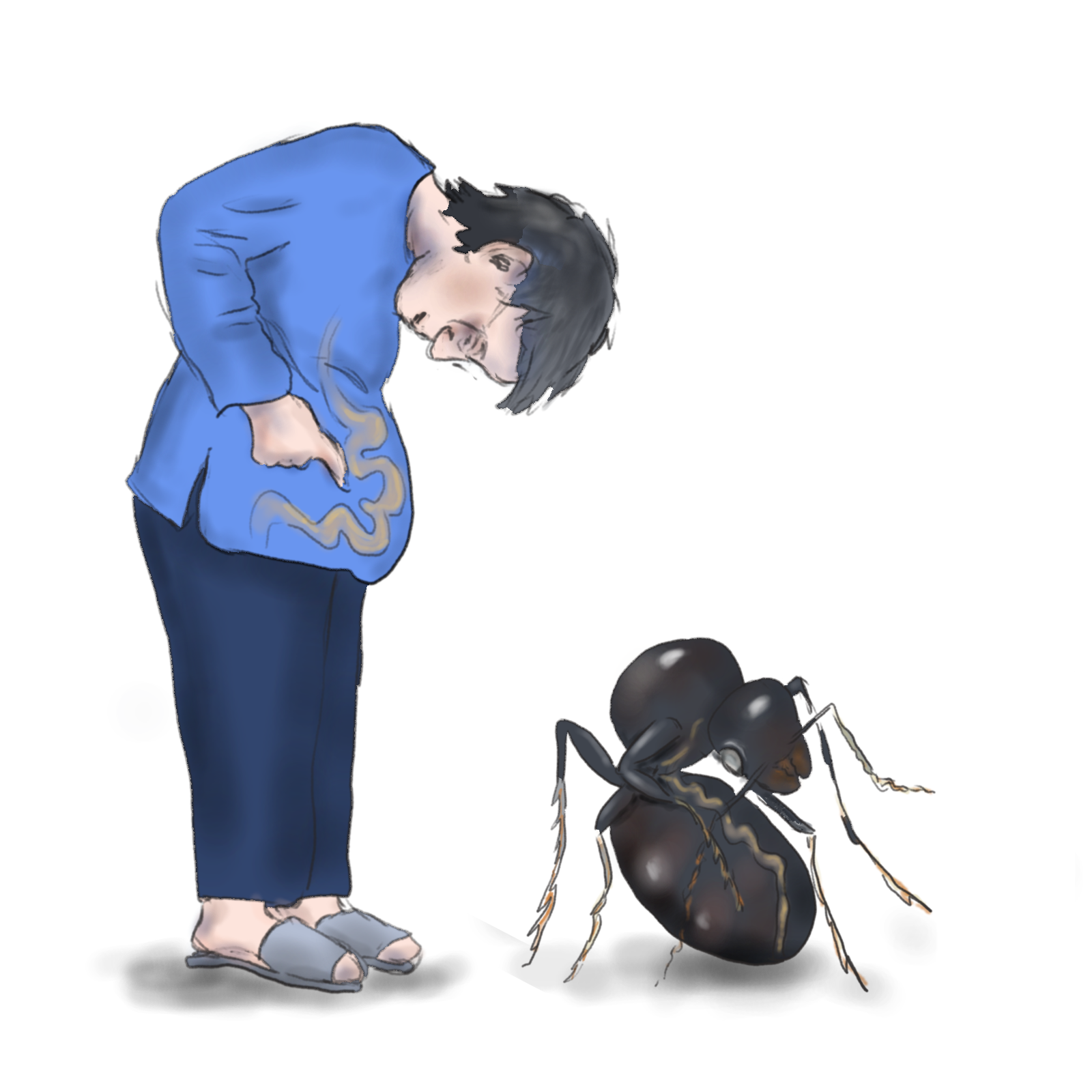
I try to cross the membrane of my cell to reach that ball inside that is the nucleus and Lola Cleopatra does the same with her cell.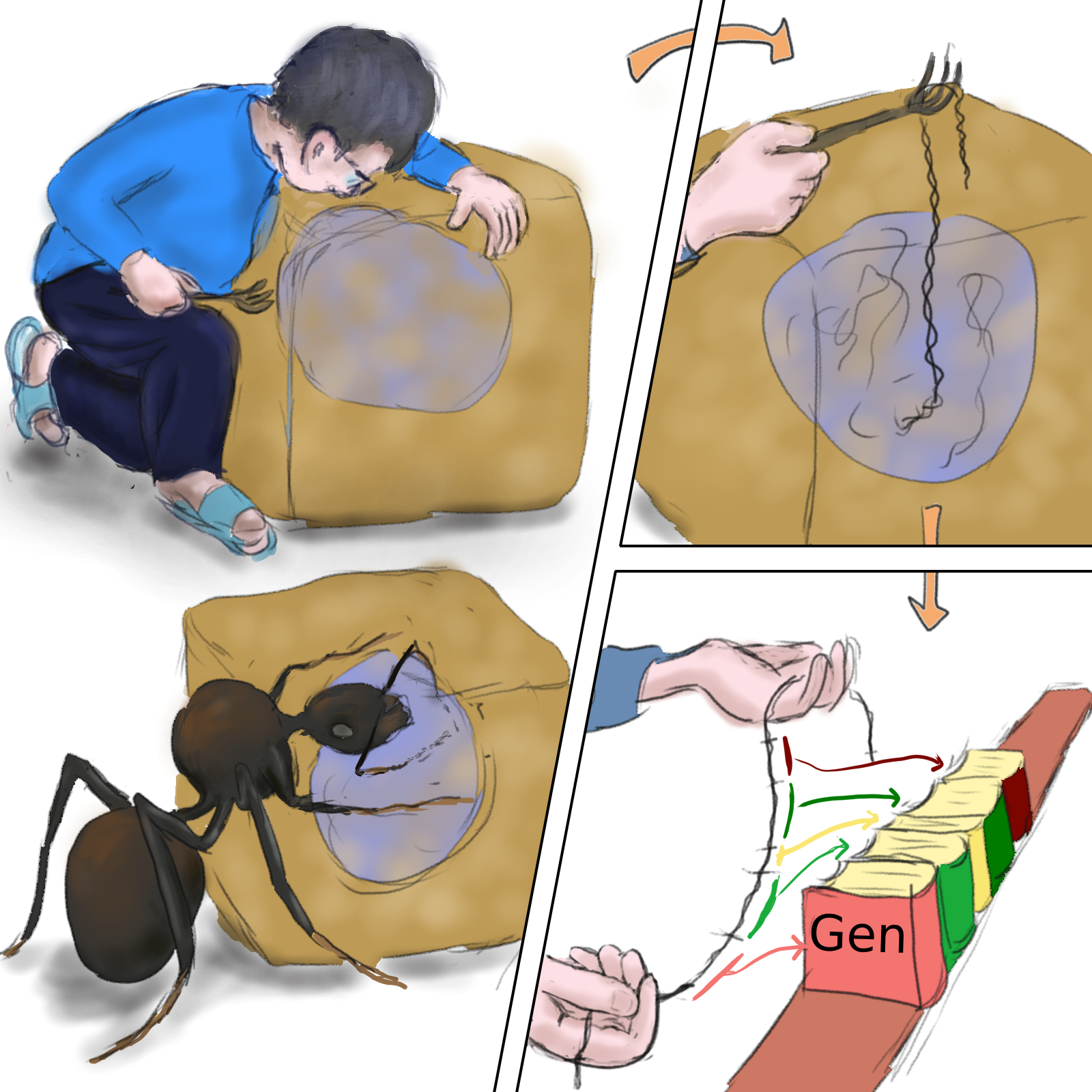
The nucleus looks like it has a noodle soup, I manage to get one out, it's a chromosome. The chromosome has written on it many important programs for the functioning of that cell and many others, that that cell does not use because they are written for other cells. Each chromosome would be like a shelf that contains many books and pamphlets with instructions, each one of those instructions is a gene.
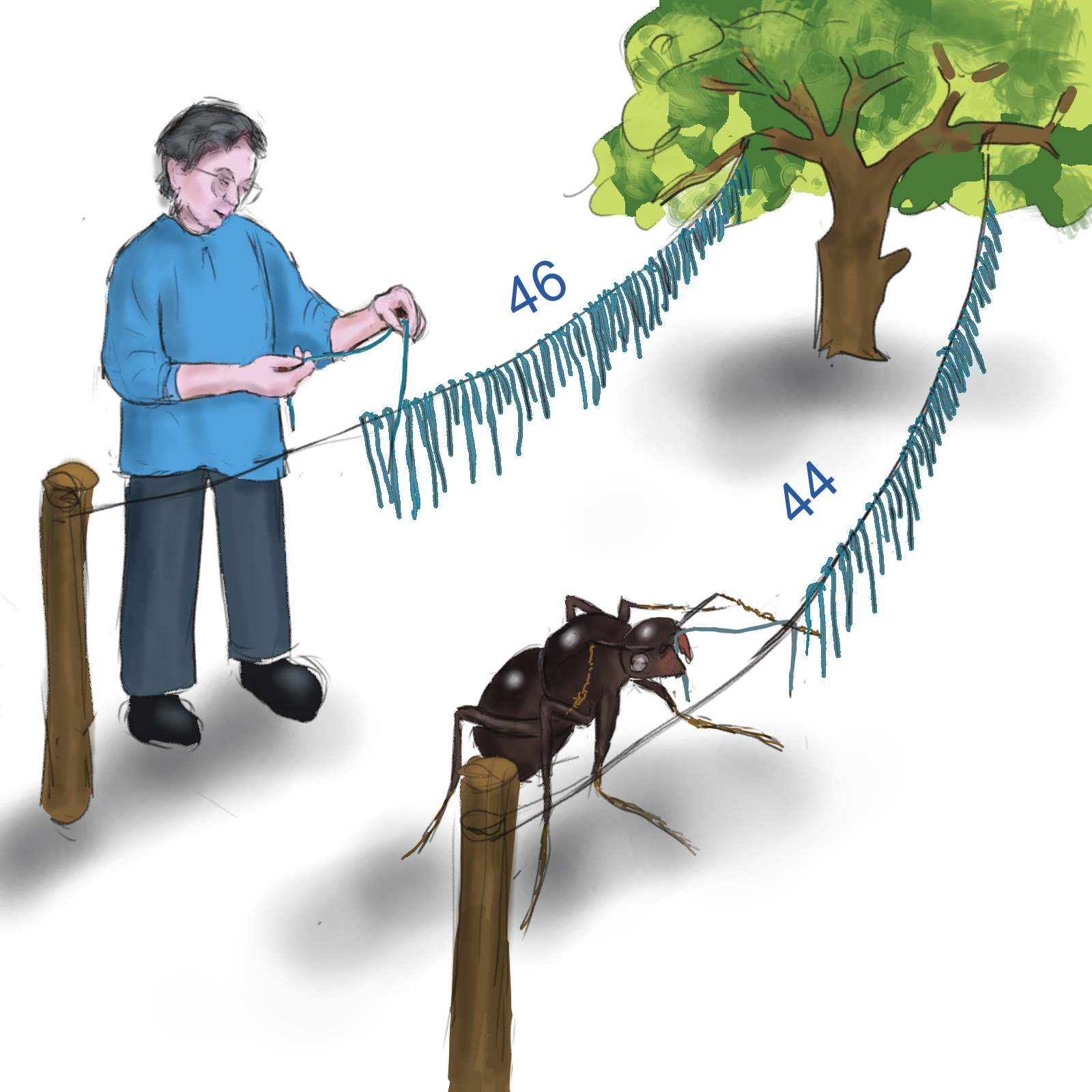
Lola Cleopatra and I have managed to remove all the chromosomes from our two cells. I have found 46 chromosomes and Lola Cleopatra 44. They are not all the same, there are longer and shorter ones.
It turns out that our chromosomes come in pairs, one of them comes from our mother and the other from our father.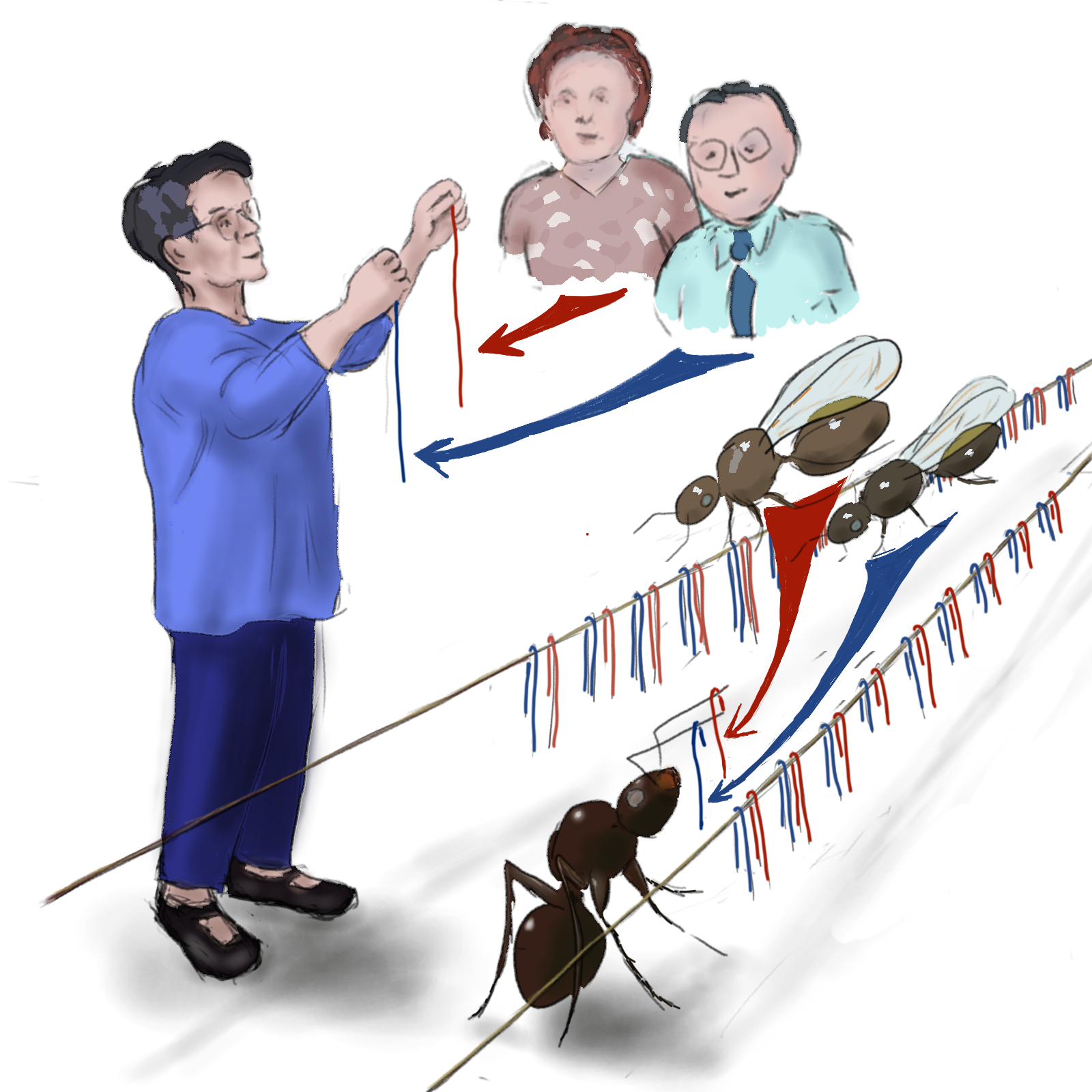
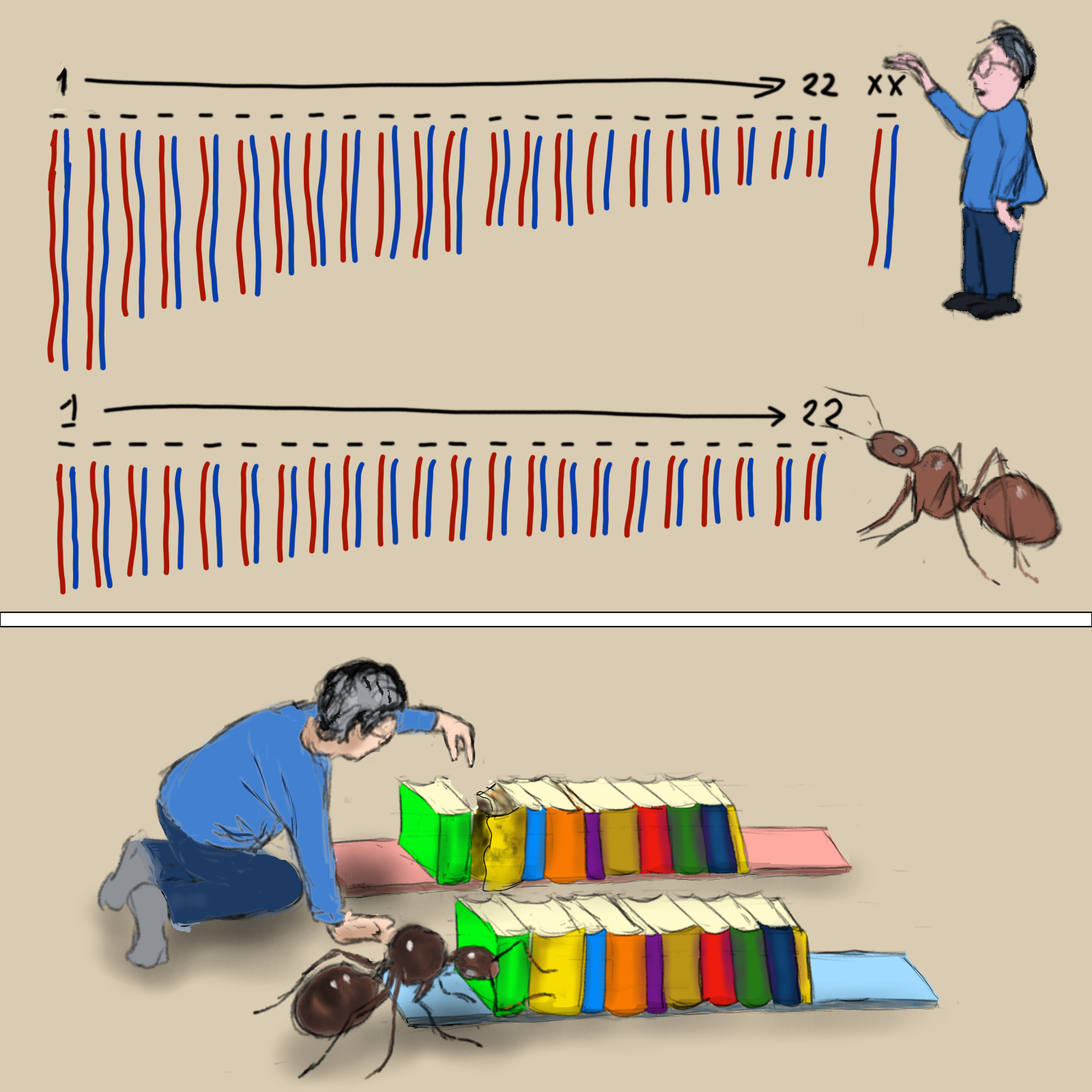
The researchers numbered the pairs of chromosomes, from largest to smallest. So Lola Cleopatra has 22 pairs of chromosomes numbered from 1 to 22 and I have 22 pairs numbered from 1 to 22, but I also have a pair of large chromosomes that are outside the normal numbering, that pair is called XX.
Each pair of chromosomes has the same programs. If one of the programs on one chromosome is broken, the cell can read the program from the other chromosome.
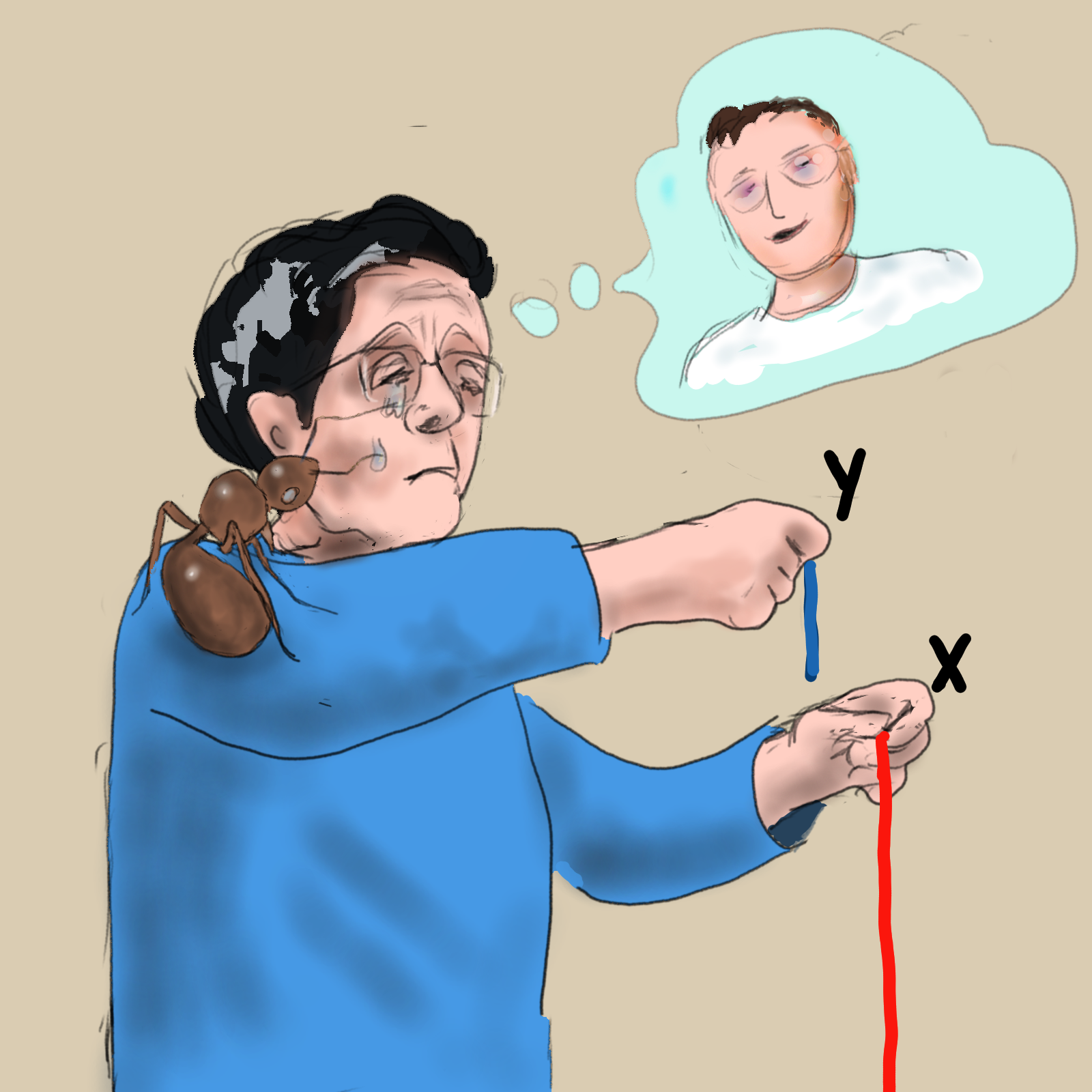
One thing saddens me 😢, my son has 23 pairs of chromosomes, like me, but in the last pair, the chromosome he inherited from his father is very short, and it is called Y. So he has a long X chromosome and a tiny Y. If any of the programs on the long chromosome of that pair is defective, it could not compensate for it, because the other chromosome (the Y) does not have those programs.
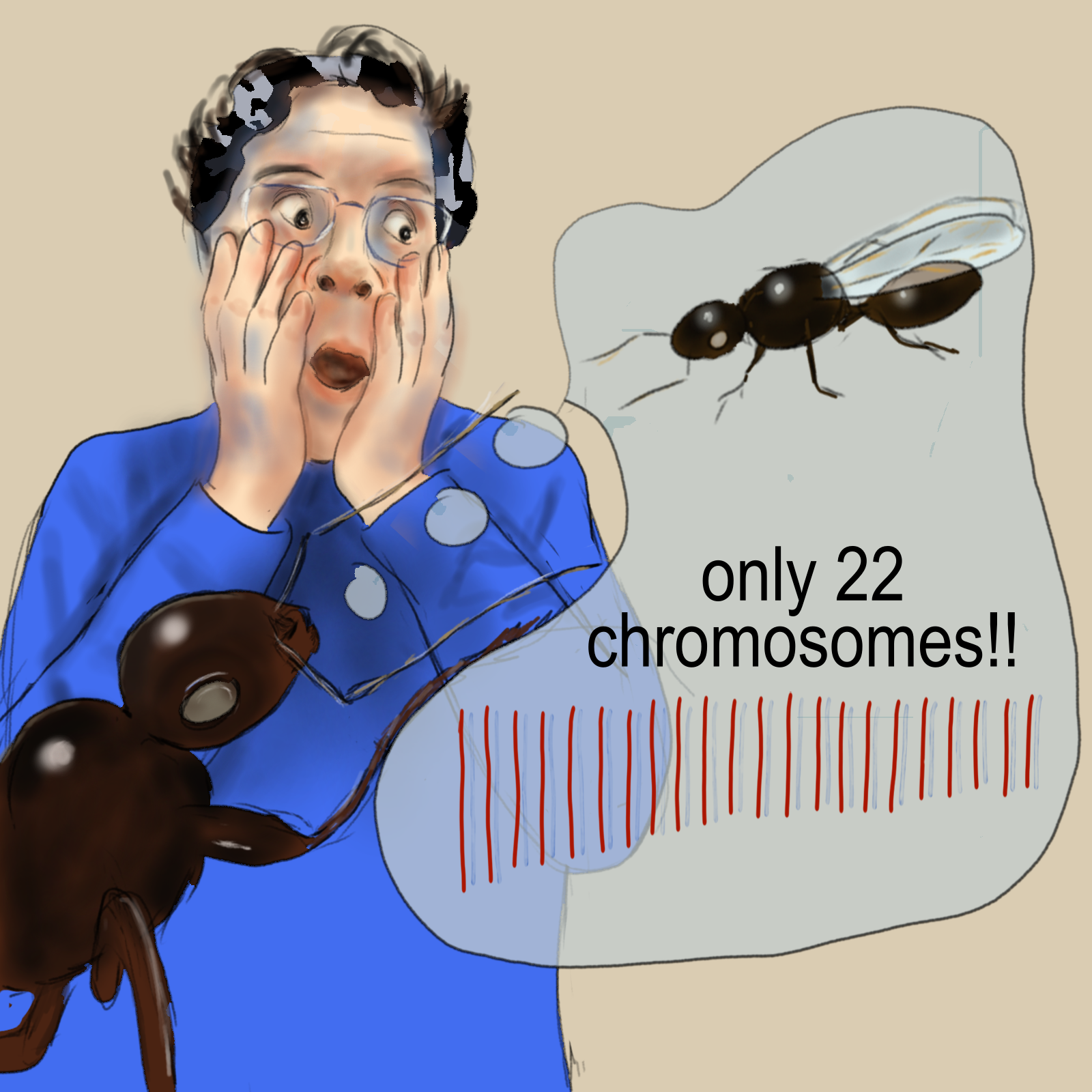
Lola Cleopatra consoles me, she tells me that she doesn't have sons yet, only daughters, but when she does, her sons won't even have pairs of chromosomes, they won't receive any chromosomes from their father, they will only have 22 chromosomes, not 44. If there are a flaw in any major program they will die.
The normal division- MITOSIS
Look Lola Cleopatra! It looks like one of the cells in my gut is starting to divide.
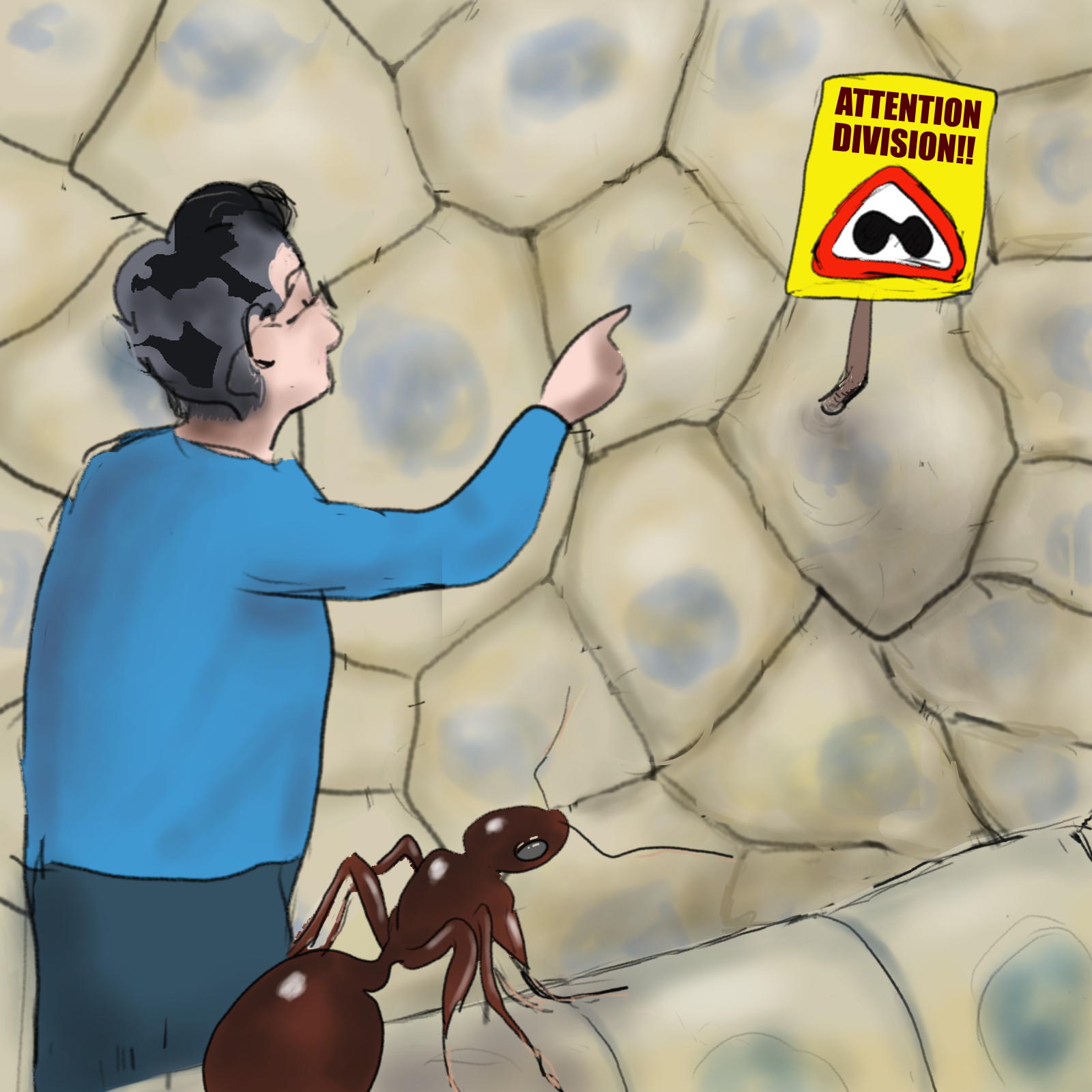
She's making a copy of all the pieces of the cytoplasm.
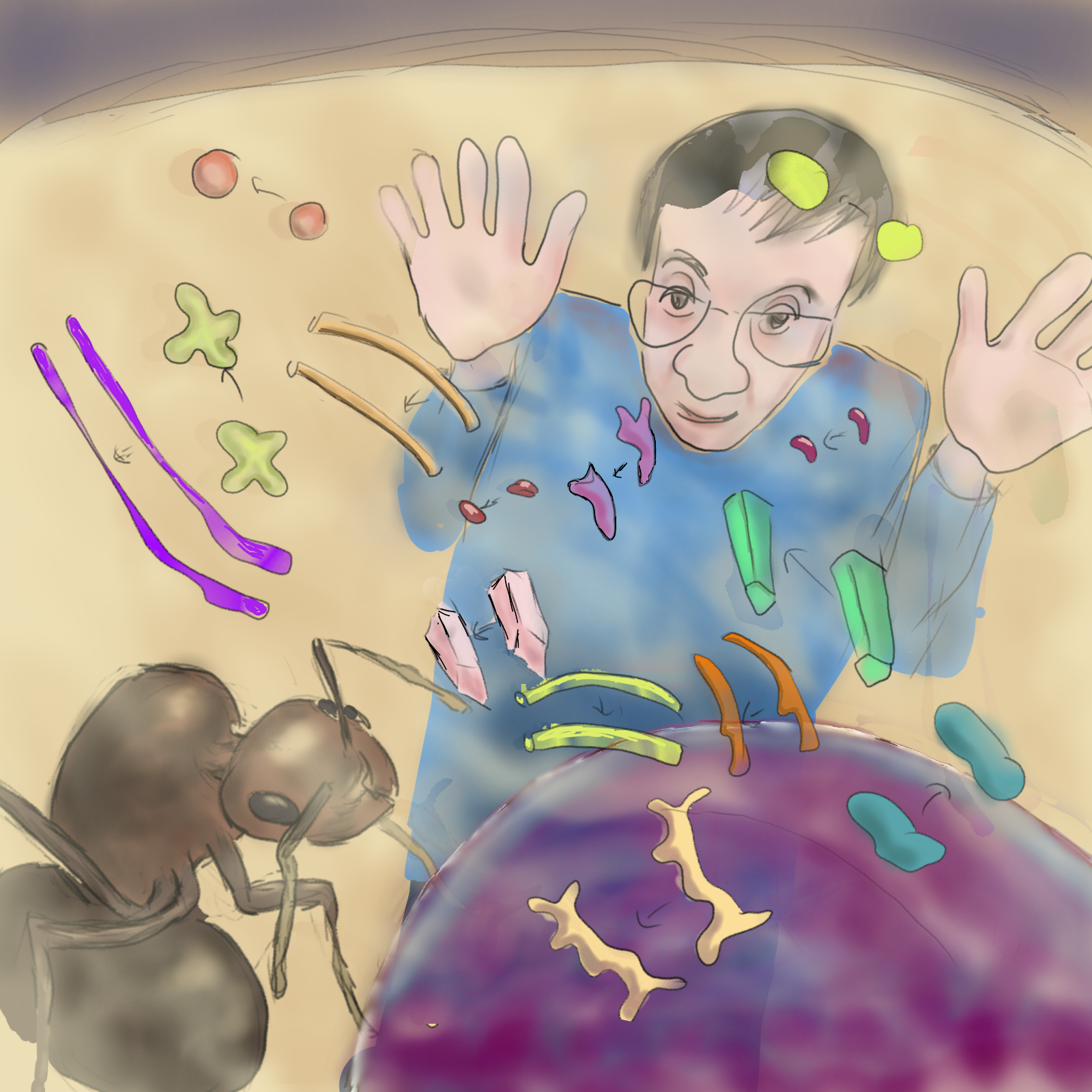
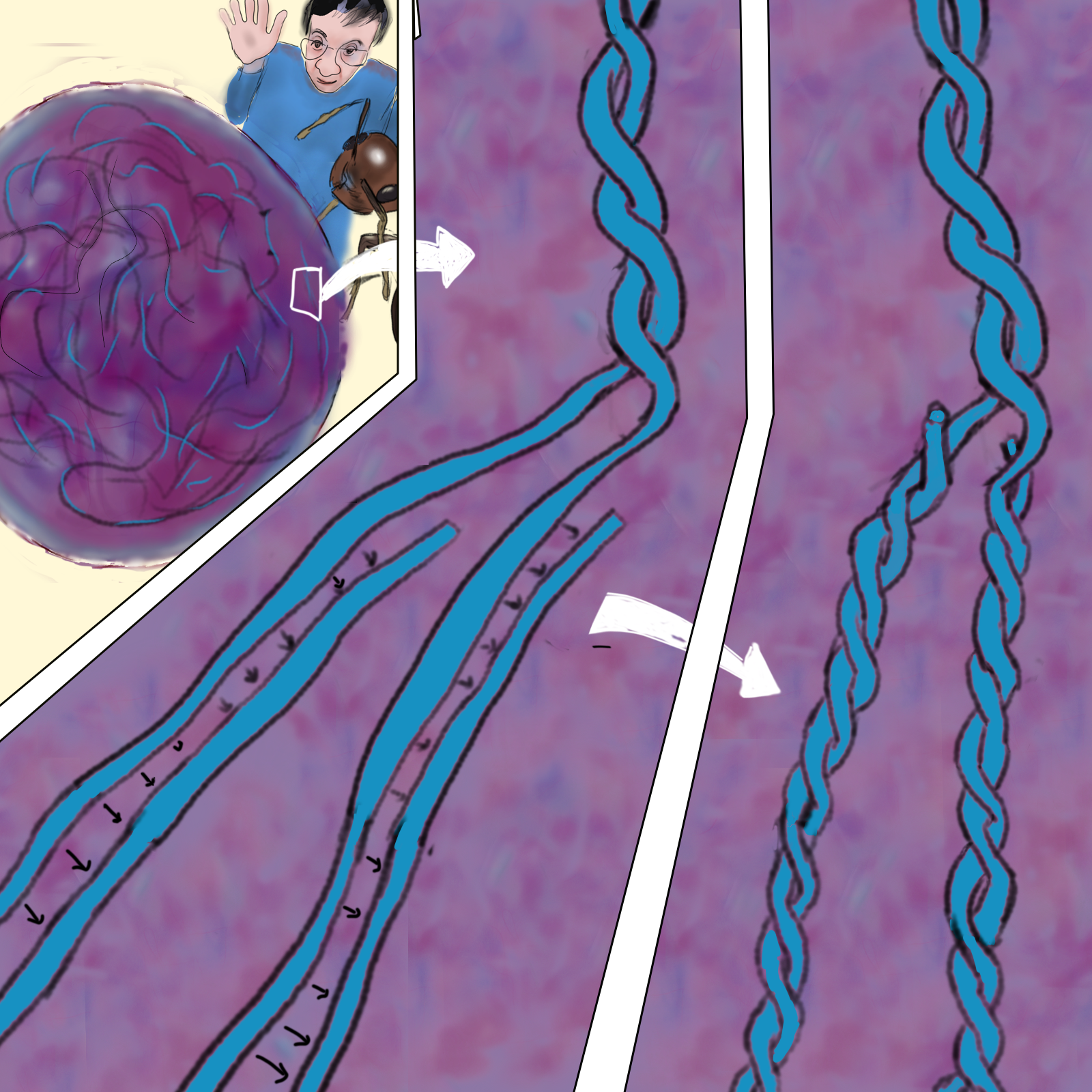
Look at the nucleus! Their chromosomes are also being copied. Each chromosome is two joined wires, first it separates the two wires and makes a copy of each of the wires that wrap around the copied wire again.
Almost all the pieces are already duplicated and now the division of the nucleus is going to begin, it is what scientists call MITOSIS (it is a normal division of cells, not like meiosis, which is a special division of reproductive cells.
I have built some special inventive glasses to be able to see mitosis better. I think Lola Cleopatra's glasses would fit better on the antennae, because they are more sensitive than her eyes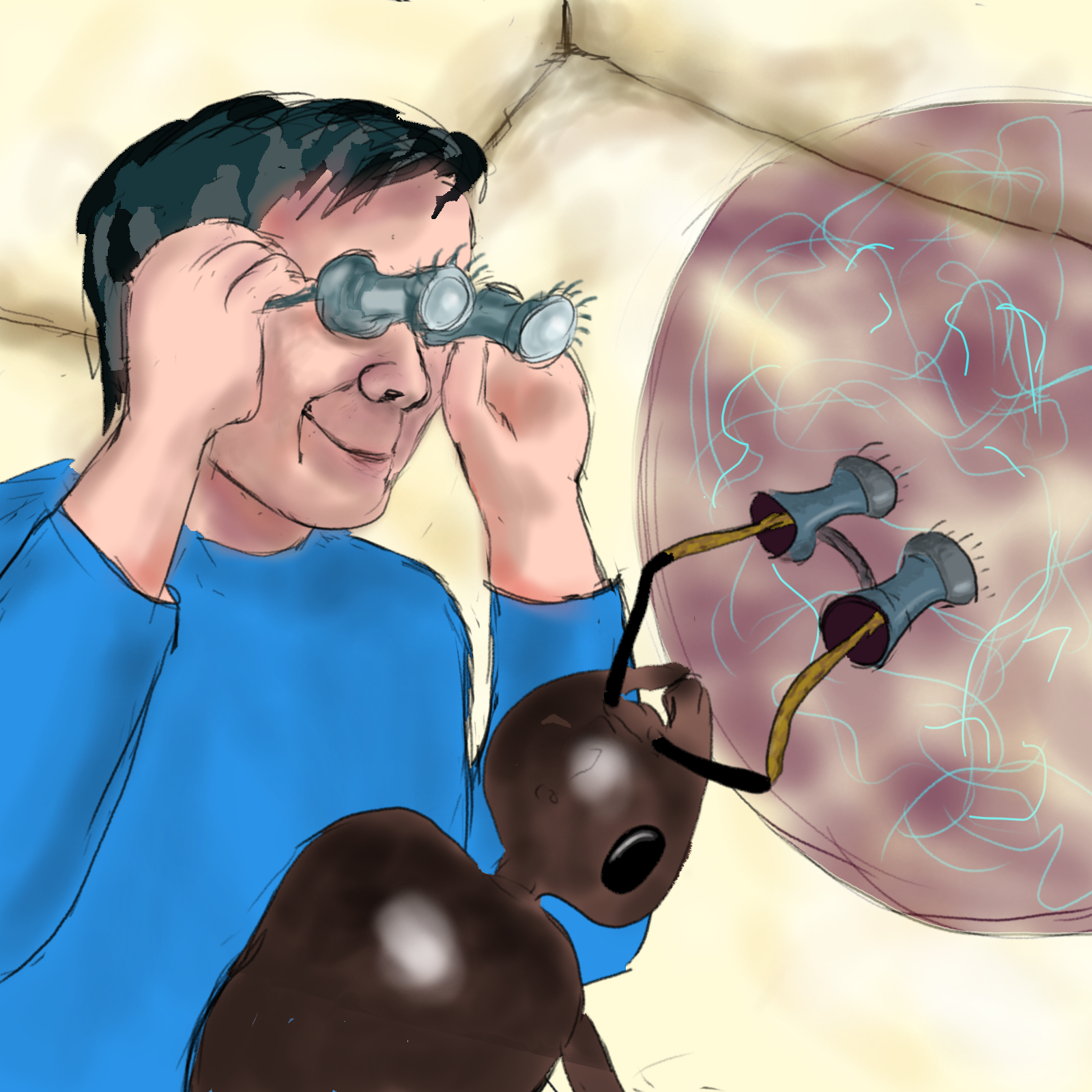
What are those little beings with a number tag? there are as many as there are pairs of chromosomes, Lola Cleopatra and I call them Cocromas, (in spanish, those that COnocen the CROmosoMAS), in English they would be called Knochromes (the ones that KNOw the CHROmosoMES). They're breaking the membrane of the nucleus, the chromosomes are spreading throughout the cell.
The Cochromas go out in search of their pair of chromosomes. There we see the cochrome 2 that has found the pair 2 of chromosomes (you know, a chromosome that came from the father and another chromosome that came from the mother). The cochroma holds one of them with one hand and another with the other. Since each chromosome had been duplicated before, each hand now has two chromosomes.
Look at how the cochroma is concentrated! The long strands of chromosome curl up, they no longer look like noodles but rather sausages, and they can be seen very clearly.
The duplicated pieces of the cell are distributed on both sides of the cell, the central fibers of the membrane would be the equator of the cell, the two large green pieces, which are the centrioles, are placed at the opposite ends of the cell.
Meanwhile, the cochromas with their chromosomes in their hands, head towards the center and align with the fibers of the equator, clinging to them with their hairs.
When they are in place, they call out to the two centrioles, which look like octopuses with many arms. Each centriole launches a tentacle into each hand of the cochrome and begins to pull it. The cochroma divides into 2, carrying a copy of its chromosome in each hand.
The hairs of the cochromas that have extended to the cell membrane, pull on the shrink wires, while the cochromas are dragged by the legs of the centrioles (dark green). The membrane is closed until the cell is divided into two cells.
[ Every time I find myself with more problems to tell my stories, not even the imagining glasses are capable of solving some. For example, I wanted to explain how the cell split in half after distributing its contents; It would be like pulling the tape from a garbage bag, the tape would be in the middle of the cell and you have to pull it from the inside. I thought it would be a good idea to have the cochromas pull her with their hairs, but I wasn't able to draw it.]
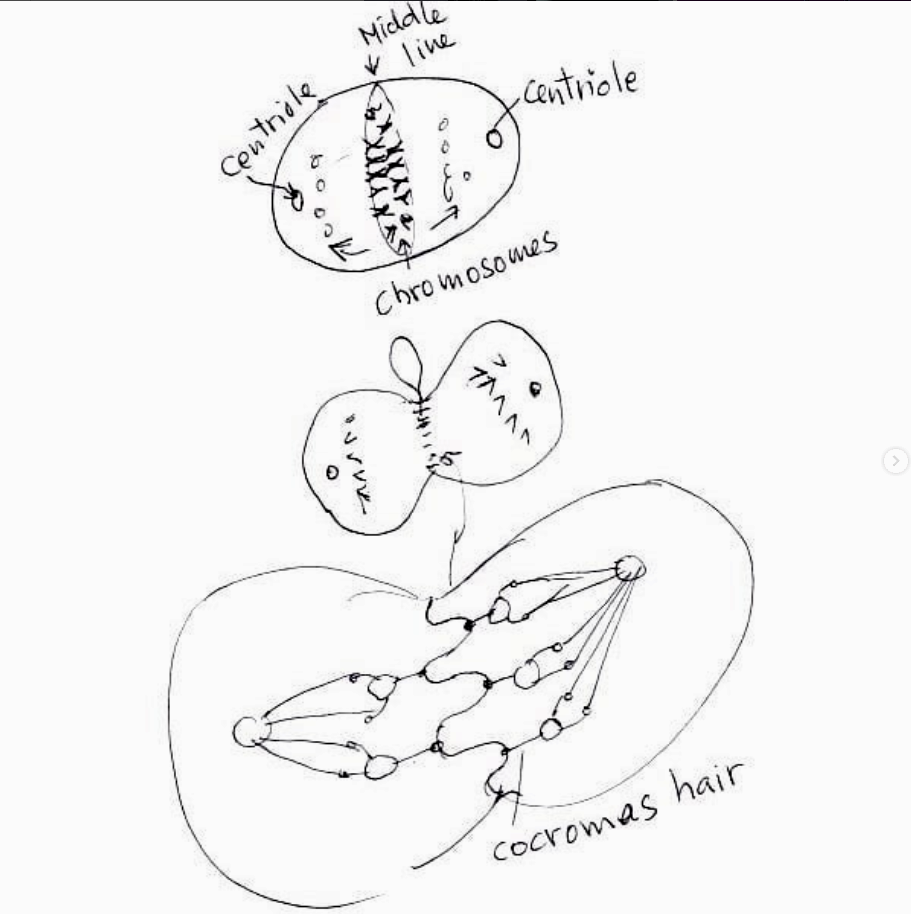
The legs of the centrioles release the cochromas and the cochromas release their chromosome, which uncoils again and occupies the entire cell.
The cochromas enclose the chromosomes again, building the wall of each nucleus.
After a cell division with MITOSIS the resulting cells are the same.
The result of a MEIOSIS is completely different as we will explain in the next chapter.
Comments powered by CComment