


Cells and Supercells
I've been discussing our strong resemblance to my queen ant, Lola Cleopatra.
As explained in the chapter "why we are so similar to ants", we are both made up of a large group of cells that carry in their nucleus the information from the book of life, called DNA, and outside the nucleus, in their cytoplasm, the interpreters. of DNA strands.
Many of the chapters of that book of life (genes) are the same in Lola Cleopatra's cells and in mine, although they may be in a different order.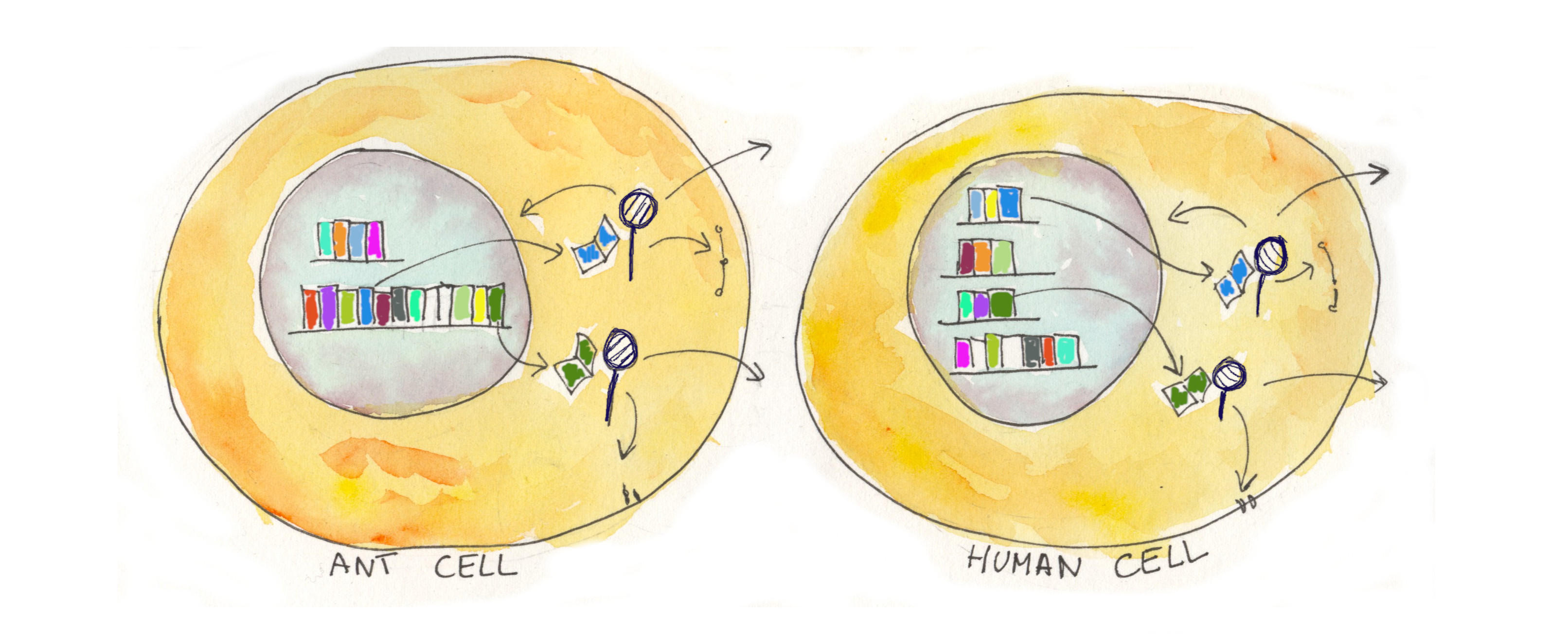
Both my queen ant and I have groups of cells specialized in different things, such as movement, secretion, or nervous or endocrine control; each of those cells interprets a few chapters of that great book of the nucleus.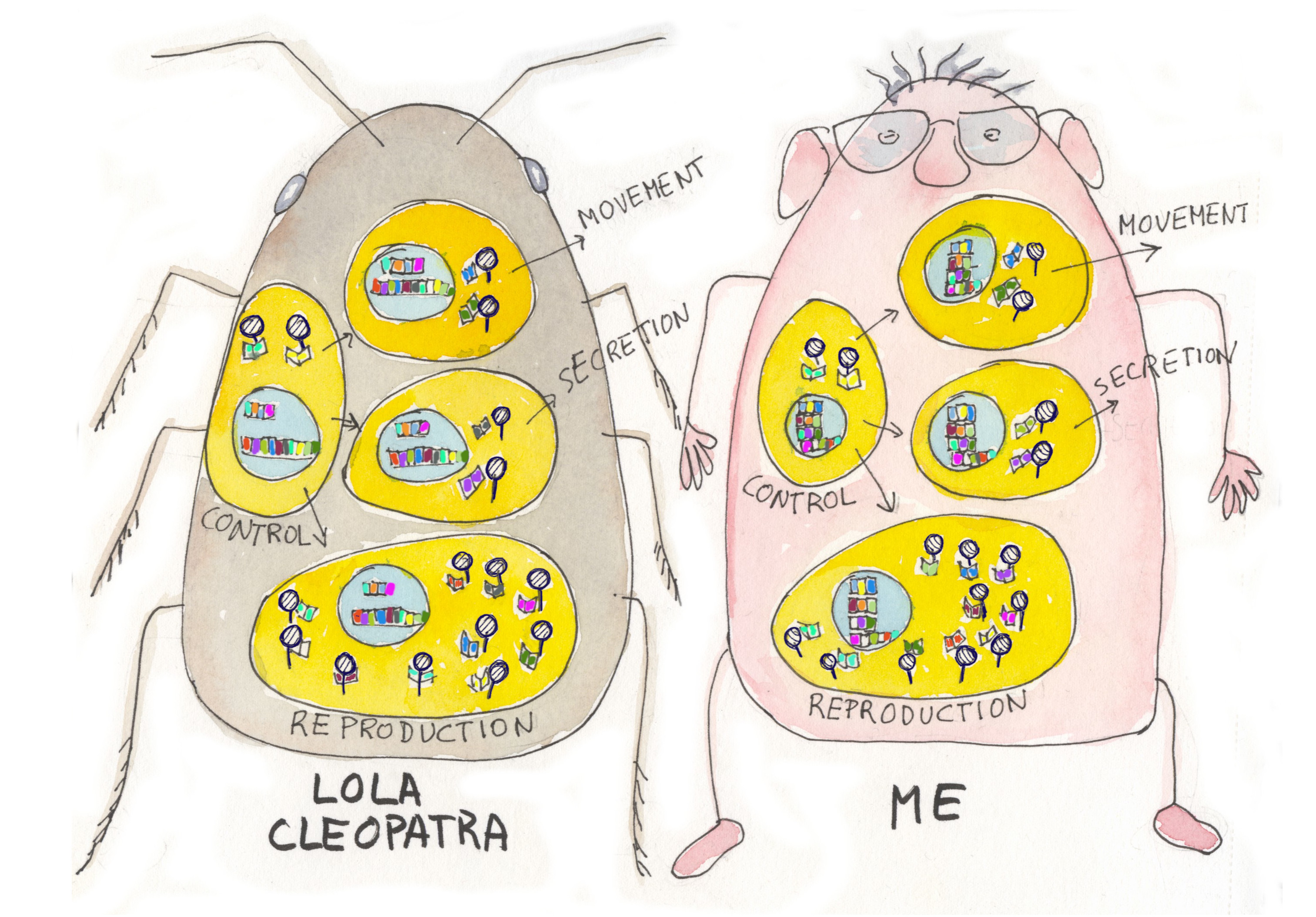
But Lola Cleopatra and I also have some "supercells" that have the plans of our bodies in the cytoplasm, use many more interpreters and are capable of reading many more chapters of the book of life. They are the oocytes, they are found in the ovaries and are capable of dividing following the plan set out by the interpreters to produce a new ant or a new human. That is, they are dedicated to REPRODUCTION.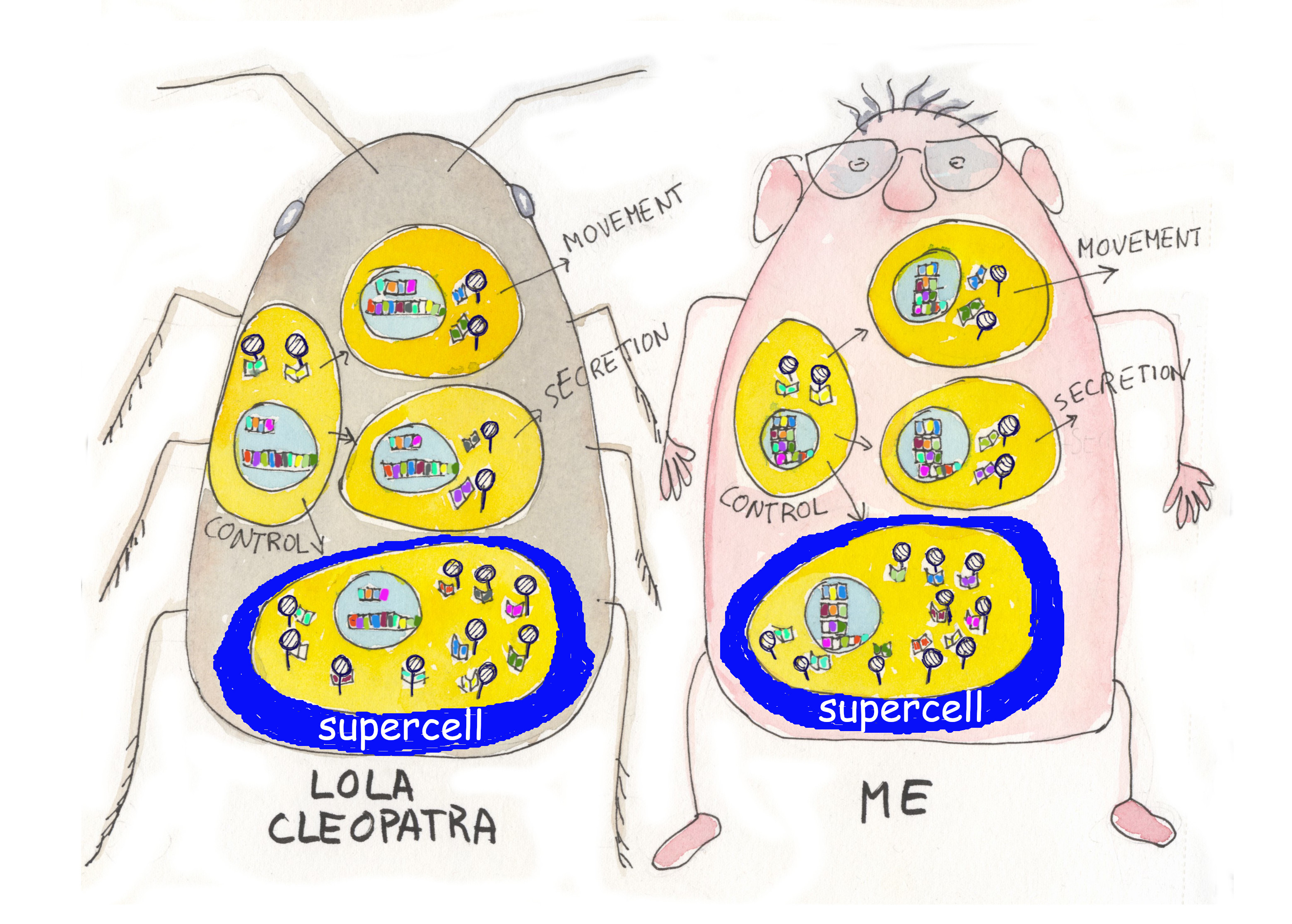
Lola Cleopatra finds the issue of reproduction interesting; I have to explain to her that we humans have long ceased to find the topic of reproduction interesting. However, due to the nostalgia of having been my first research topic, I decide to make a comparison between the human reproduction and that of ants, provided she helps me, of course.
Reproduction, the beginning
I have decided to start telling you about the similarities and differences between me and my queen Lola Cleopatra starting at the beginning, when we were very small and only made up of one cell.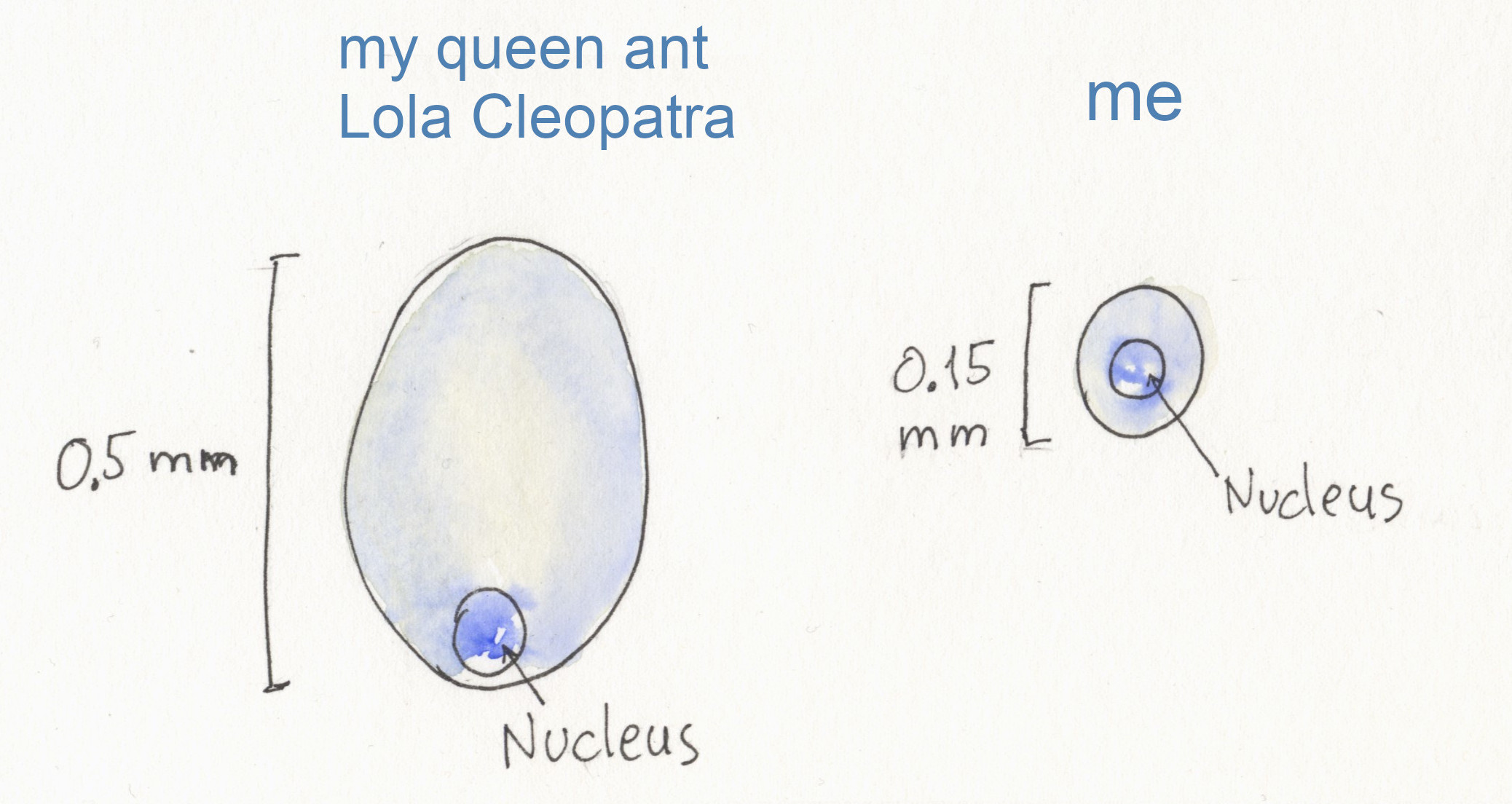
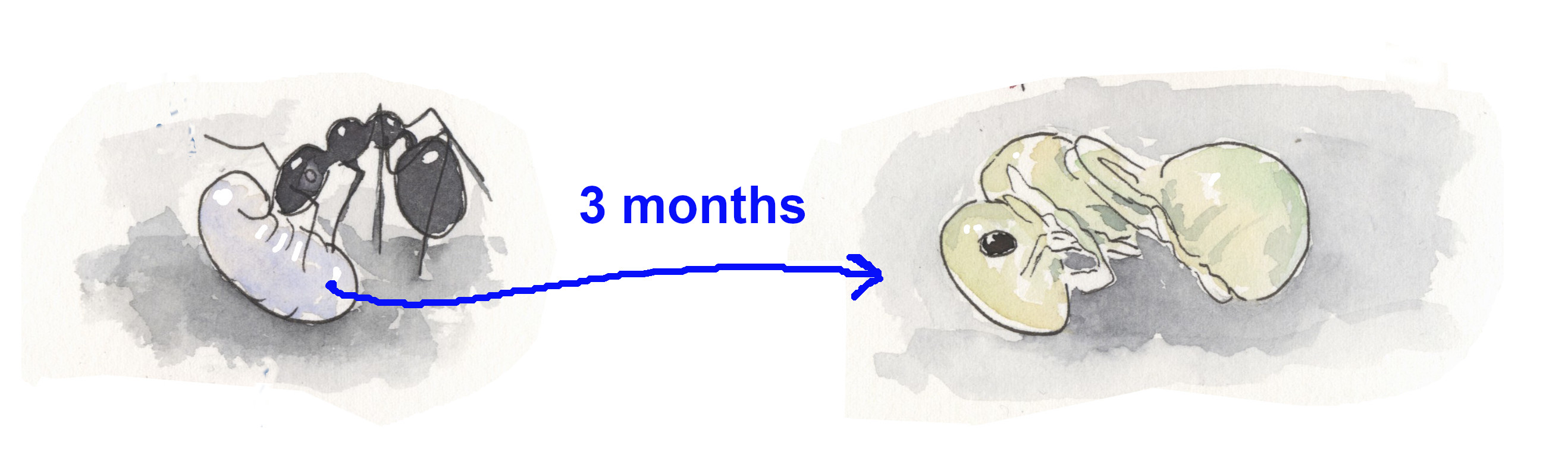
It was a special cell, the largest and most complex in the entire body of our mothers. As you can see in the drawing, Lola Cleopatra was much bigger than me, only her cytoplasm, because our nuclei were almost the same. That's because that cell went directly to the outside world and needed a lot of reserves to survive until it divided many times and formed a mouth where her sisters could feed it.
On the other hand, I followed a path inside my mother's uterus full of nutritive secretions while I was dividing into more cells, part of those cells were breaking my mother's uterus, until I was buried inside, they also broke many blood vessels and They formed a blood pool where I could get food quickly and easily. As I got older I formed blood vessels that brought me food from my mother's blood pool.
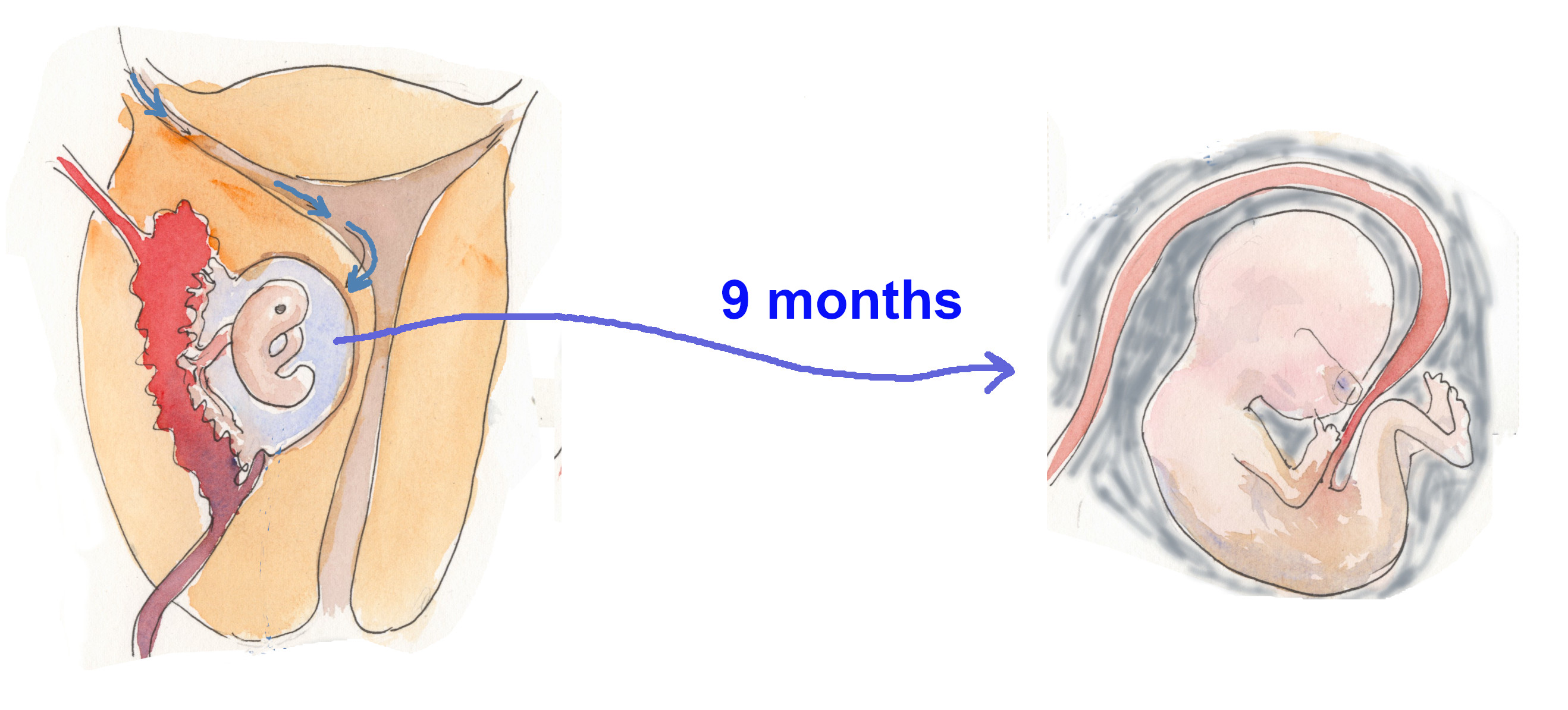
After 3 months, Lola Cleopatra was already a pupa and was about to be born, measuring approximately 1.2 centimeters, the same as she would measure throughout her adult life. After 9 months I was about to be born too, I was 46 centimeters tall, but I would continue to grow for 13 years, until I was gigantic compared to Lola Cleopatra.
Despite our differences, when we were born, both my queen ant and I had developed cells from our respective ovaries.
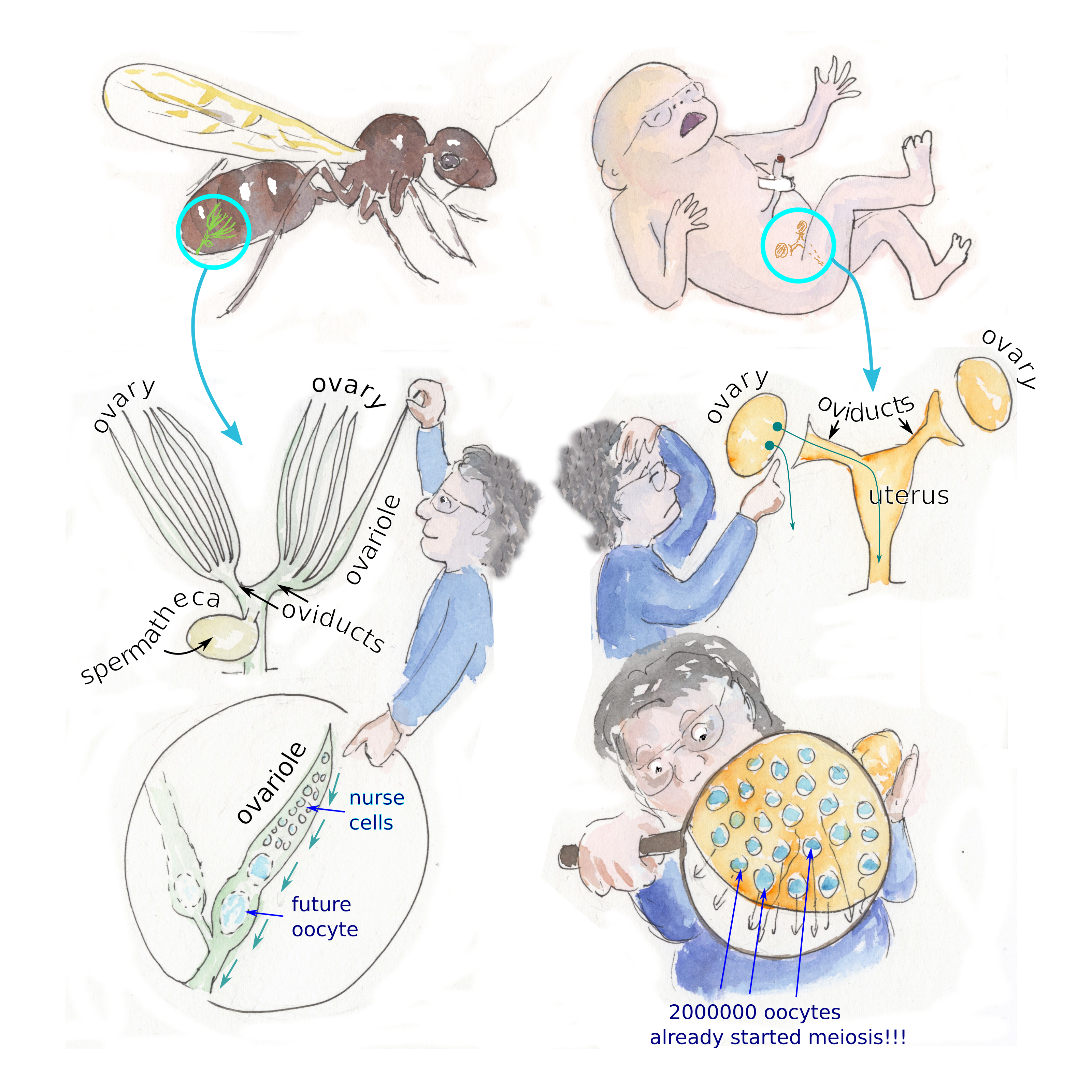
At birth, my queen ant Lola Cleopatra had 2 ovaries each made up of 40 ducts called ovarioles; in them the oocytes are formed in an orderly manner from other cells. The oocytes will be forming and making their special division of the nucleus (meiosis) throughout the life of the ant, I have not been able to find the data, but I suppose that it will not have oocytes already formed at birth. As you can see in the drawing, the ovarioles are continuous with the oviducts and these with the common duct that leads to the outside and where the spermatheca also ends. A simple, elegant and effective design.
I also had 2 ovaries at birth, but they looked like 2 potatoes, the worst thing was that they didn't even communicate directly with the oviducts. The reproductive cells of one of my ovaries could come out of any part of its surface and fall into the oviduct or inside my abdomen. In addition, my ovaries had 2 million oocytes, which had already started the first meiosis. What was a girl like me doing, who has 20 or 30 years left to start her reproductive life, with 2 million oocytes? These that I tell you are not the only failures,
I'm sure many of you will agree with me that human reproduction is a design disaster.
Nothing else could be expected from a family branch focused on building mountains of cells and being able to control them all. On the contrary, the family where the ants come from dedicated itself to perfecting the reproduction systems, coming up with very ingenious solutions.
It continues in the division of normal cells: Mitosis
Comments powered by CComment