


Lola Cleopatra took the opportunity to lay a few eggs while I was sweating doing the animation from the previous chapter: the division of normal cells or MITOSIS.
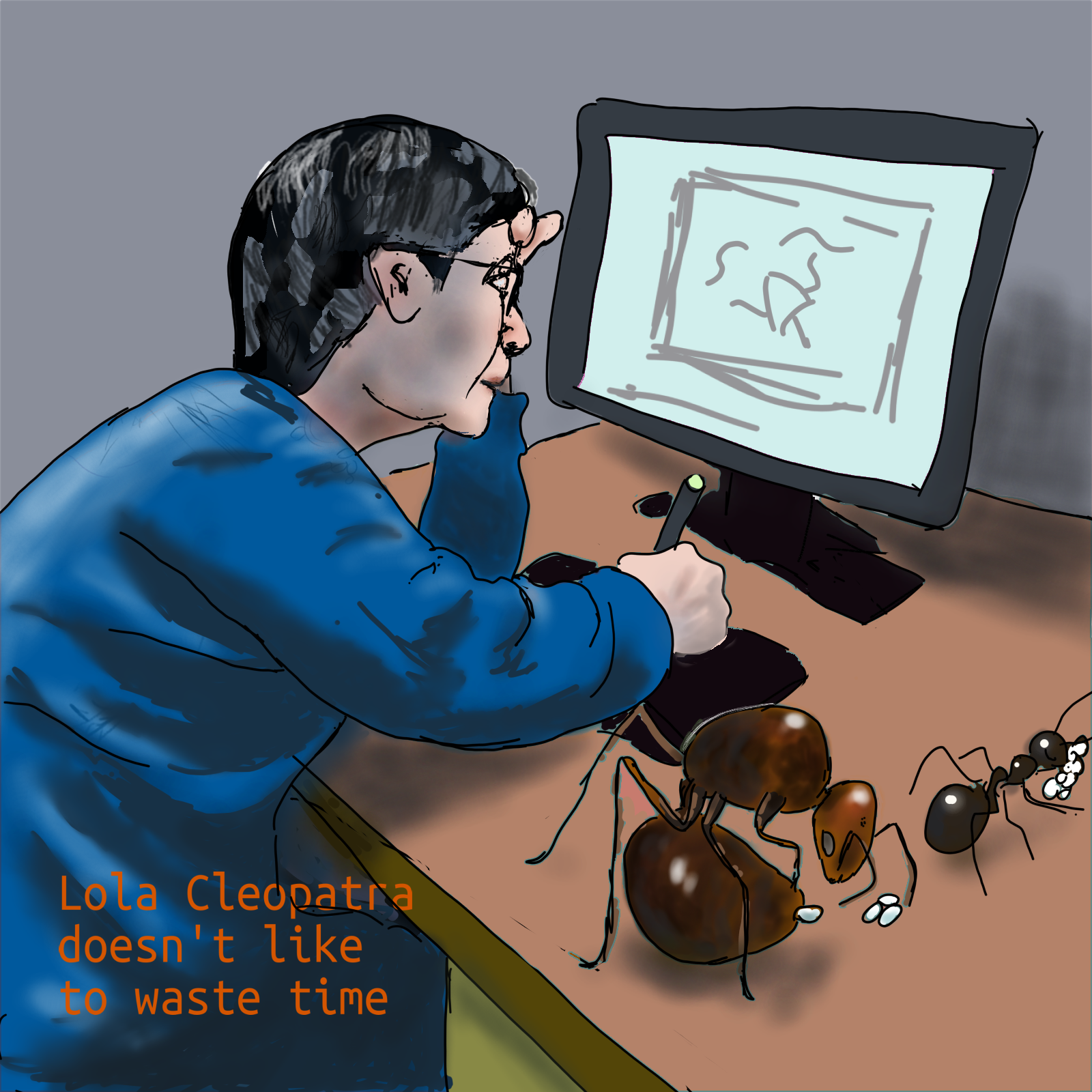
- Lola Cleopatra! We have finished explaining the division of normal cells, now we can explain the division of our special progenitor cells.
- We need a progenitor cell, in our case it would be an oocyte. The bad thing is that I don't have any left.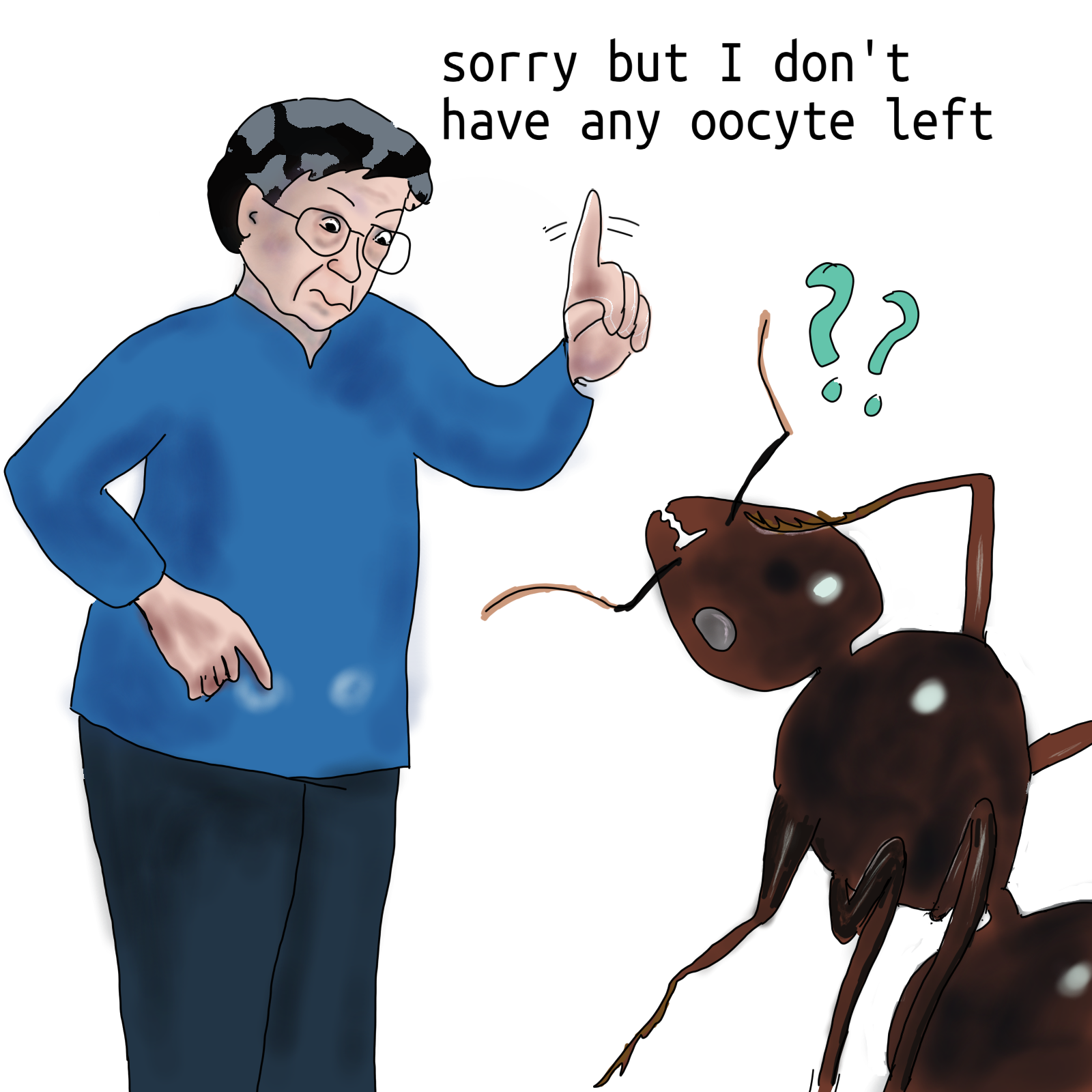
Lola Cleopatra looks at me surprised, - weren't you born with 2 million oocytes? have you spent them all?
- No, they have been dying alone. Before reproductive age, a million and a half had already died.
I think I've given Lola Cleopatra pity and she decides to show me how one of her oocytes works. She was not born with all the oocytes in her ovaries, but rather she manufactures them throughout her life from special cells of her ovarioles.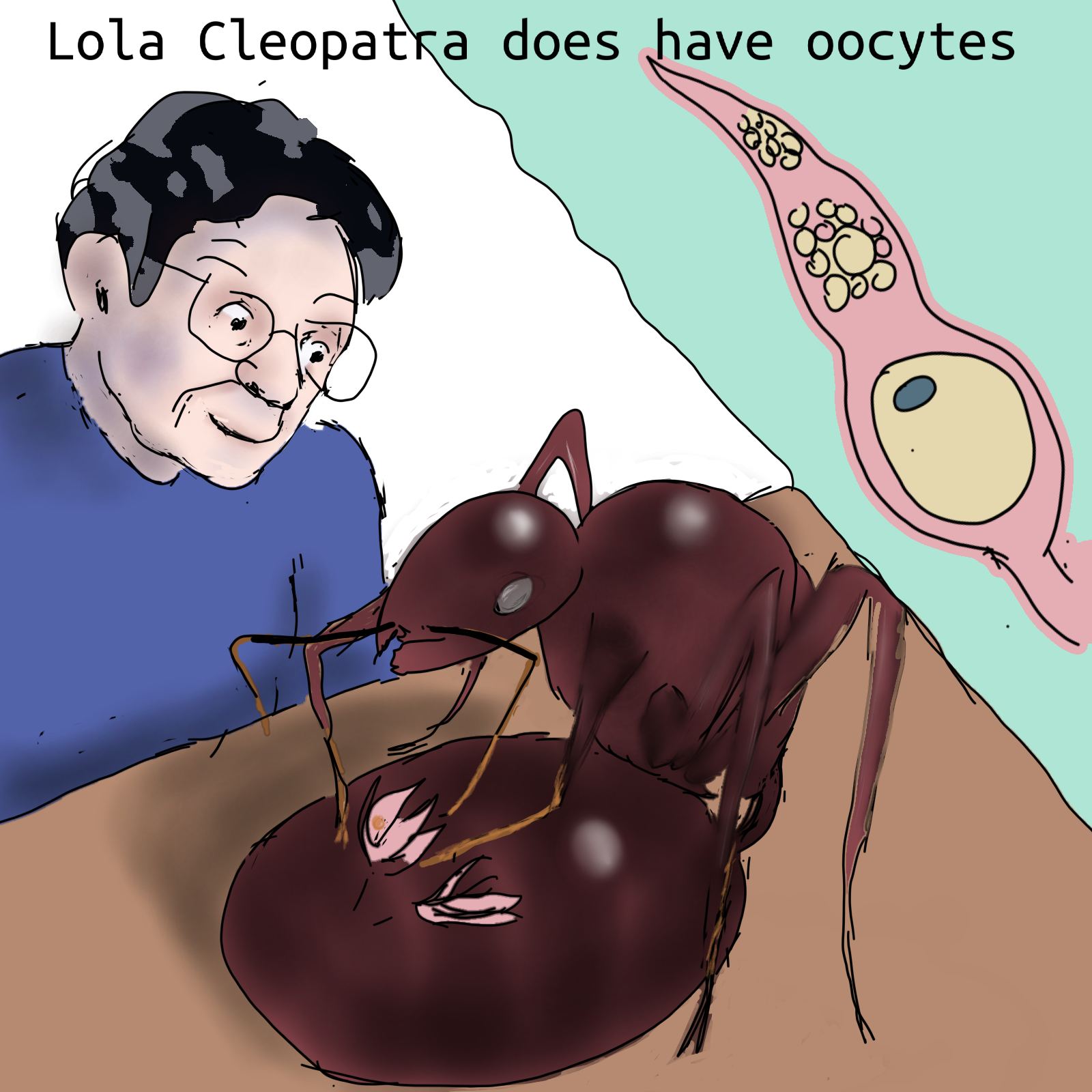
After putting on our imagining glasses we will begin to see the special division of the nucleus of the oocytes, the MEIOSIS
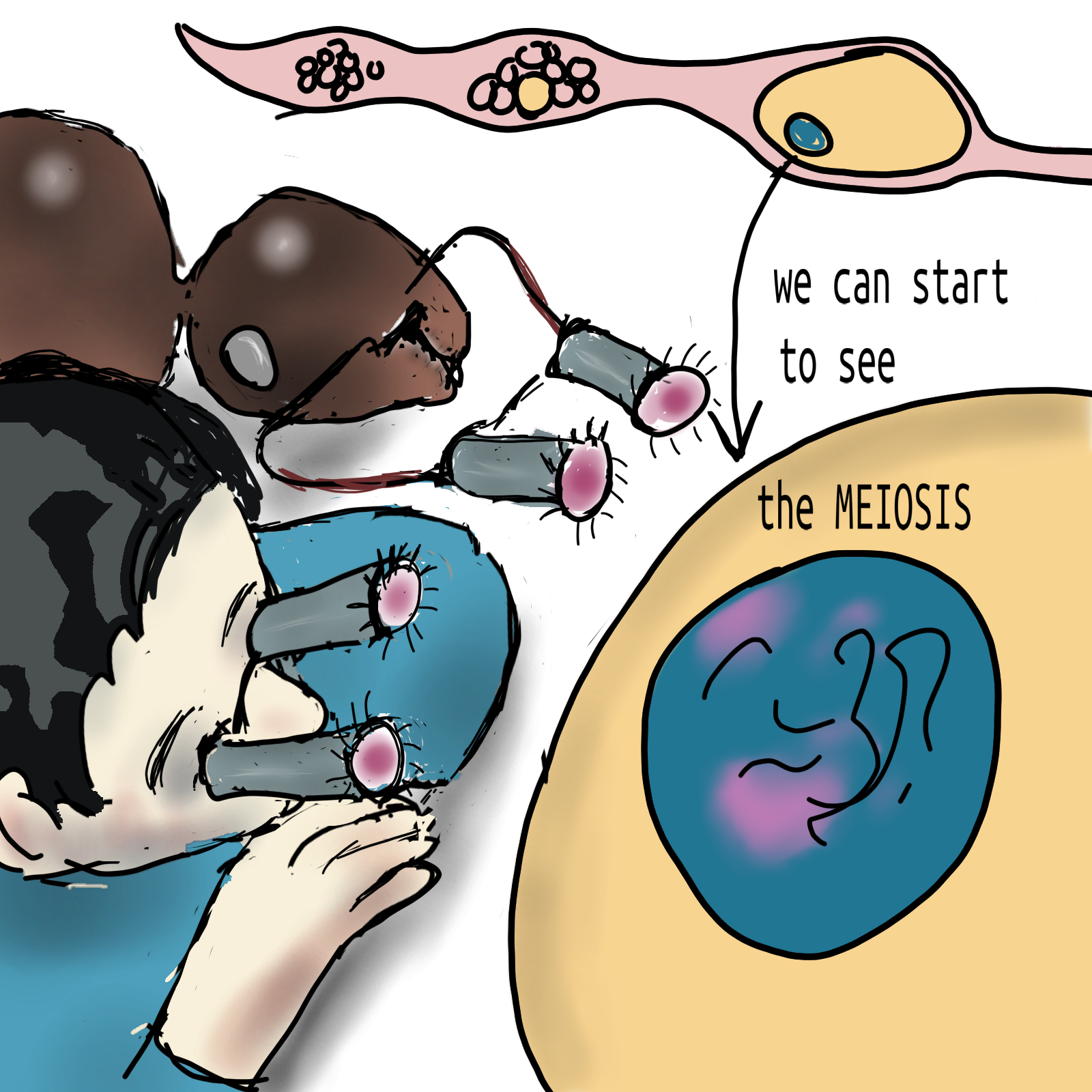
-Look Lola Cleopatra, your oocyte is growing and the nucleus is going to start dividing.
-The nucleus seems very small.
-It's not small, it's normal size, but the oocyte is huge!
-Pay attention, the oocyte divides twice, these two divisions produce 4 cells, but one of them, which will be the mature oocyte, remains with all the cytoplasm.
In the cytoplasm are the necessary tools and programs to form a new individual, in this case, as the oocyte comes from Lola Cleopatra, it will be an ant.
In these two divisions the nucleus loses half of its chromosomes. That is what we want to see in detail with our imagining glasses, the MEIOSIS.
The cochromas of the oocyte are different from those of the other cells: they are embroidery cochromas.
Lola Cleopatra's oocyte has 22 embroidery cochromes, one for each pair of chromosomes.
-Lola Cleopatra, let's focus only on cochrome 2.
-The Cochroma 2 calls the chromosome 2 from outside the nucleus and when it arrives it sews one end to the wall.
- Why does the cochroma sew the ends of the pair of chromosomes 2 to the wall of the nucleus?
- So that the chromosomes do not get twisted or knotted when the cochroma sews them inside the nucleus.
-The 4 ends are already sewn, now the cochroma enters in the nucleus to start the embroidery of its pair of chromosomes.
The embroidering cochrome is already inside the core. Her pair of chromosomes (number 2) has already been divided, so she will sew 4 chromosomes: 2 that come from Lola Cleopatra's mother and another 2 that come from her father.
She first combines the maternal chromosomes very well, then the paternal ones. It then joins the paternal and maternal chromosomes. The cochroma takes great care to check that the genes on the maternal chromosomes match the same genes on the paternal ones.
It then chooses two points where it will cut the maternal and paternal chromosomes and swap them.
Everything is ready to separate the maternal and paternal chromosomes and detach them from the nucleus wall.
The embroidering cochrome stays in that position waiting for the continuation of the division of the first meiosis.
Fortunately we are seeing the meiosis of a Lola Cleopatra oocyte, which will only take a few days to continue. The cochrome of a human oocyte will be in that position for a minimum of 20 years, but if you are unlucky it can be like that for 50 years.
The embroidering cochromas wait while holding each pair of chromosomes with their hands. When the wall of the nucleus breaks, they present one pair of chromosomes to the dragging machines on the right and the other pair to the dragging machines on the left. The drag cables take their pair of chromosomes and the embroiderers disintegrate. The walls of the new nuclei are formed, and the cytoplasm of the cell divides—a very uneven division, by the way.
The larger cell will eventually form the new ant but two important steps are still missing.
- Look Lola Cleopatra, the daughter cells divided by mitosis are exactly the same. But cells dividing by meiosis are completely different, different from each other and different from their parent cell.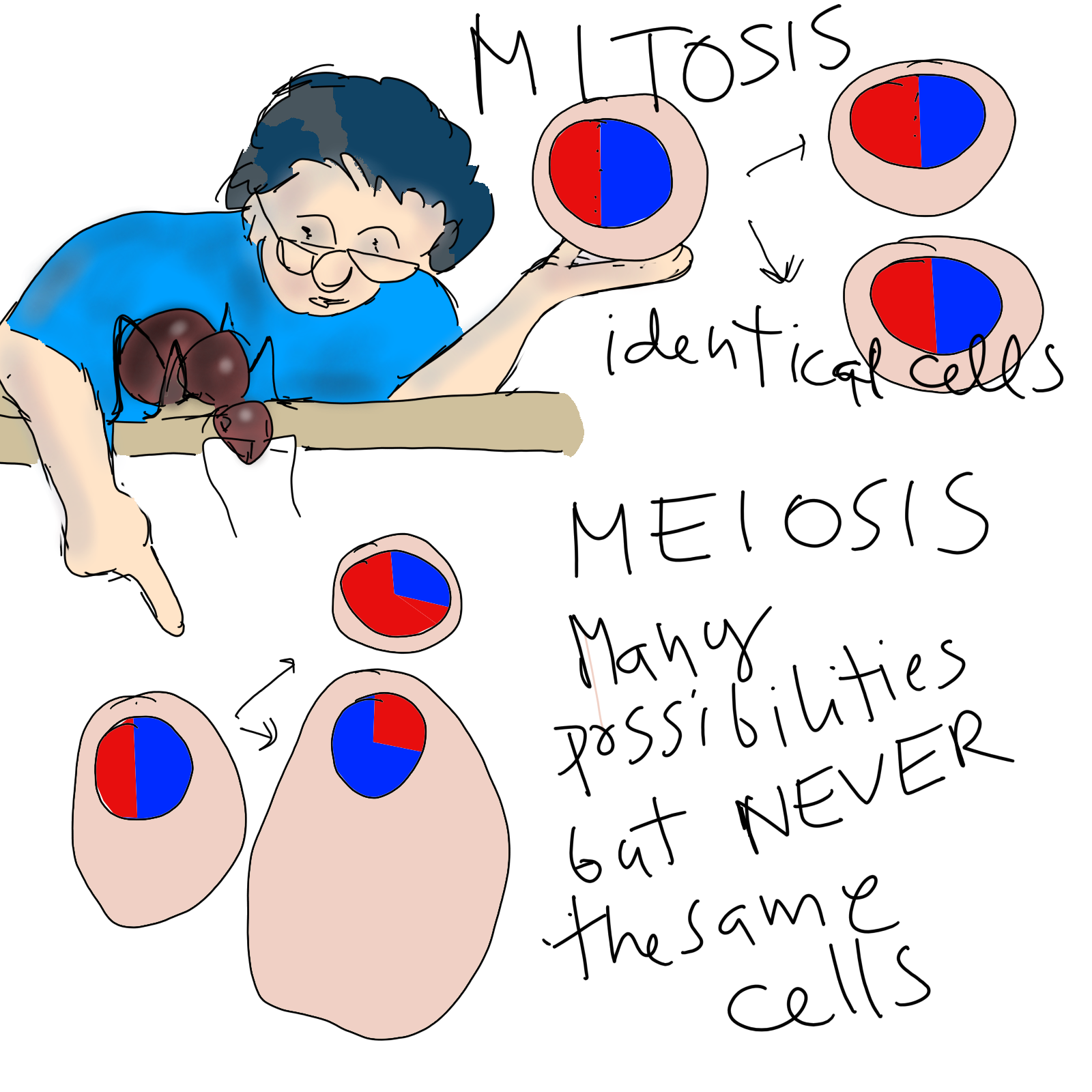
- Of course, that is the objective of meiosis to produce different lives.
- So, the fact that we two look so different is a success of many millions of meiosis, right?
Lola Cleopatra's oocyte, already enormous in size, descends through the duct that leads to the outside. The conduit passes through the spermatheca, a sac where Lola Cleopatra has stored thousands of her husband's sperm cells. As the oocyte passes, one of the sperm cells is introduced into it. The oocyte continues the second division of meiosis, it is a very rapid division because the chromosomes are not even duplicated, there are cochromes similar to those of mitosis, but they only have one arm because now there is only one pair of each chromosome; remember that in mitosis there are two couples (one from the mother and one from the father). After division, the resulting nuclei have half the chromosomes of a normal cell. Only one of the nuclei will be that of the definitive oocyte.
It is not necessary for a sperm cell to enter to continue meiosis, if none enter, the divisions will continue, the resulting egg will have half the chromosomes and will give rise to a male.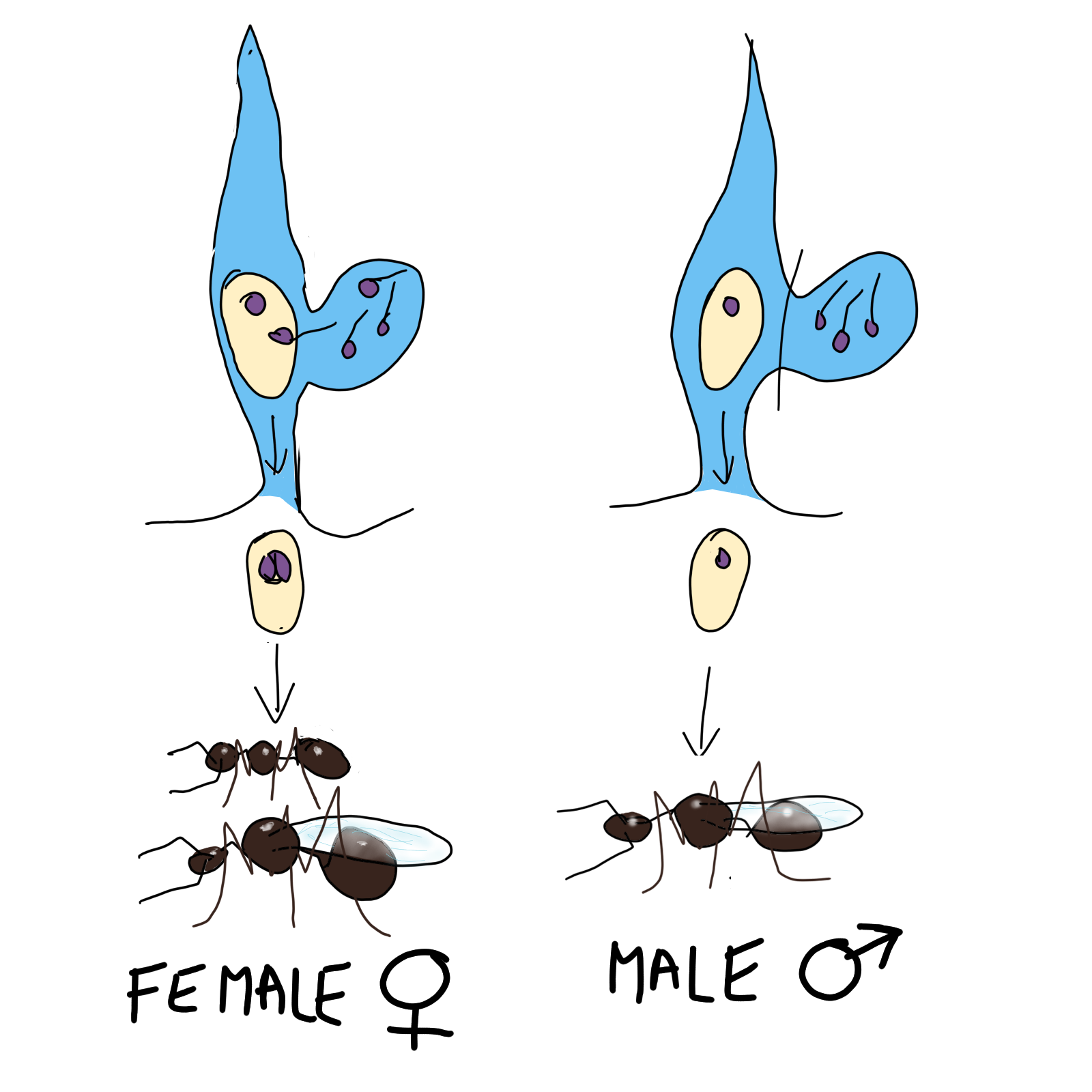
- Lola Cleopatra, don't males have a lot of risk to survive with a single copy of the genes?
-Yes, but I don't spend sperm to produce them, I can produce many, also those with genetic errors will not survive and thus will not transmit that error.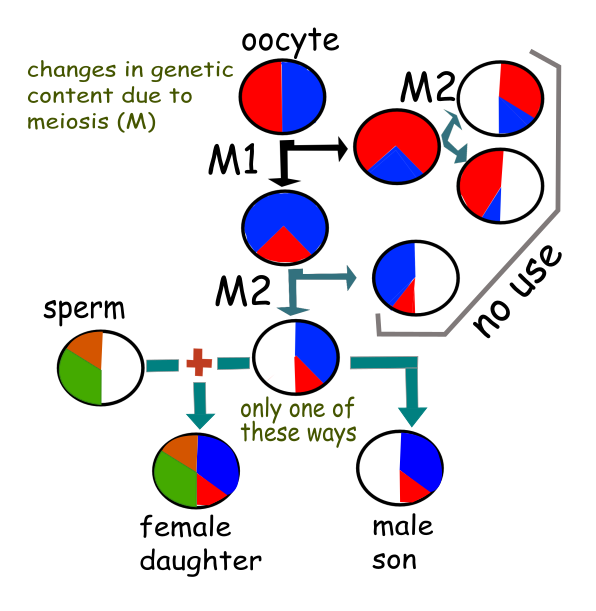
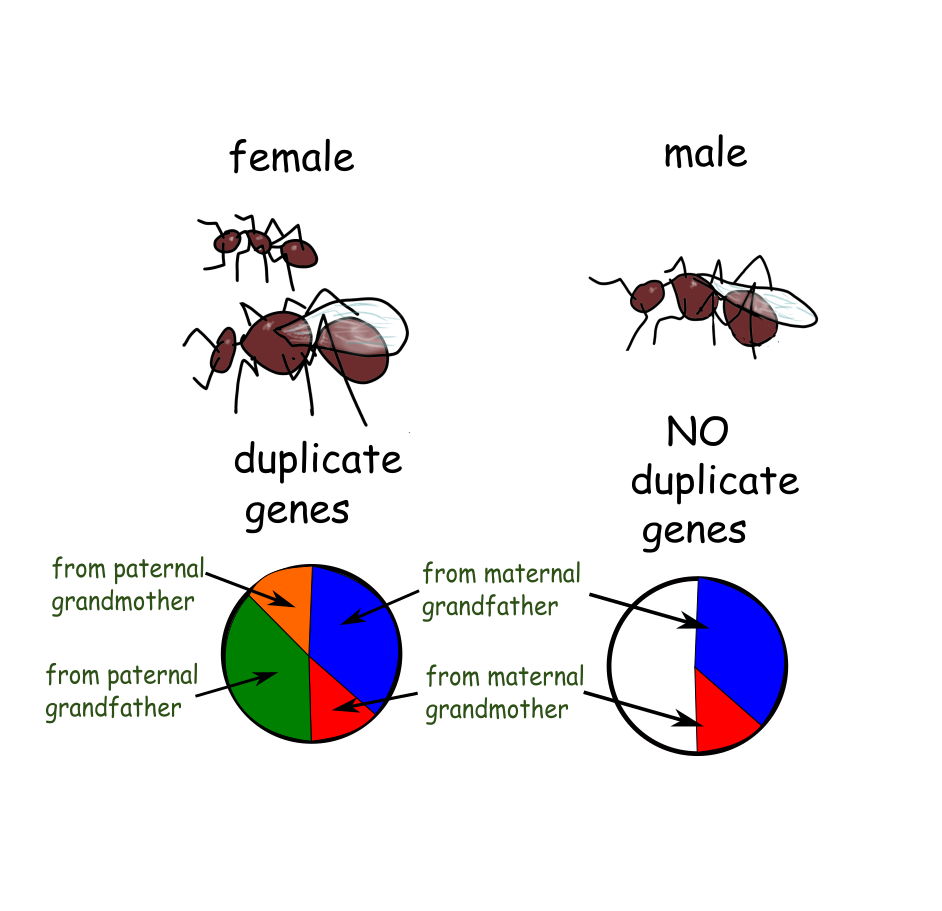
As you can see in the example of the previous drawings, the genetic content of a son or daughter is highly variable, and always different, thanks to MEIOSIS.
You will have a summary in the next chapter The consequences of meiosis.
Comments powered by CComment